Trying to design a lamp for on top of our bedposts because it's Free Real Estate™
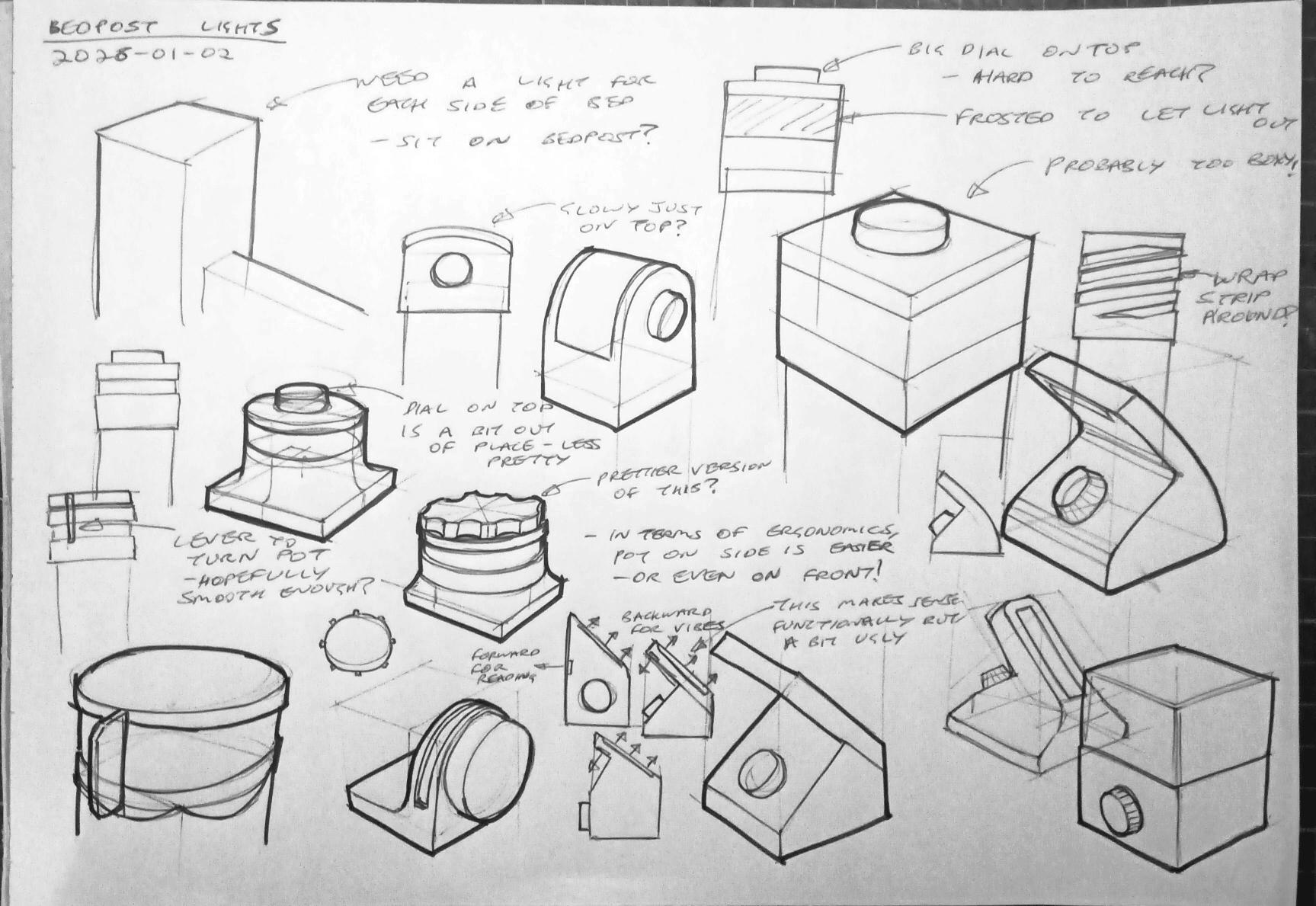
-
Trying to design a lamp for on top of our bedposts because it's Free Real Estate

@gbrnt holy wow this is so GOOD
-
@kestral thanks! Really should do this more often
-
Trying to design a lamp for on top of our bedposts because it's Free Real Estate
@gbrnt your sketches very much focus on building off the walls of the bedpost for aesthetics
But isn’t the reading material going to be at an angle off the post?
Maybe I’m imagining the utility of this poorly.
-
@gbrnt your sketches very much focus on building off the walls of the bedpost for aesthetics
But isn’t the reading material going to be at an angle off the post?
Maybe I’m imagining the utility of this poorly.
@amd yes! But the "reading lamp" part is very much a minor use case. I actually like the one in the bottom right the most - the top half of it is cloth-covered so it'll hopefully just be a nice glow
-
@amd Yeah I'd love to make the whole thing work as a giant brightness dial but I decided it's probably too hard (and not very ergonomic when you're laying in bed)
-
@s0 thanks! I think I was overcomplicating it with the earlier ones - keeping it plain and boxy fits the bedpost better and will look less obtrusive.
-
Going with a pot with a built in switch for the power so that there's less chance of lasering my eyes out with full power in the middle of the night. It'll always start at minimum brightness - if I turn it up too far it's my own fault.
Anyone know of a chip that will take in a voltage input (from a potentiometer) and output a varying PWM duty cycle?
For my lamp it just seems excessive to put a whole microcontroller in there just as a voltage-to-duty-cycle convertor. But it does have the bonus of allowing me to adjust scaling (e.g. approximate a logarithmic response with a linear pot).
-
Anyone know of a chip that will take in a voltage input (from a potentiometer) and output a varying PWM duty cycle?
For my lamp it just seems excessive to put a whole microcontroller in there just as a voltage-to-duty-cycle convertor. But it does have the bonus of allowing me to adjust scaling (e.g. approximate a logarithmic response with a linear pot).
The LTC6992 looks like what I need but just that one chip isn't enough for a digikey/wherever order and they're mega pricey on ebay (£18+ for the TSOT23 version)
-
@attoparsec Thanks, looks like I have 2 SGS (yes pre-ST merger) NE555s that would do the job! Hopefully they still work.
Does this astable multivibrator circuit look about right? I'm not that familiar with using 555s and not sure if this is LLM generated nonsense
-
@attoparsec Thanks, looks like I have 2 SGS (yes pre-ST merger) NE555s that would do the job! Hopefully they still work.
Does this astable multivibrator circuit look about right? I'm not that familiar with using 555s and not sure if this is LLM generated nonsense
@gbrnt Looks about what I remember? But that was at least 12 years ago.
-
Anyone know of a chip that will take in a voltage input (from a potentiometer) and output a varying PWM duty cycle?
For my lamp it just seems excessive to put a whole microcontroller in there just as a voltage-to-duty-cycle convertor. But it does have the bonus of allowing me to adjust scaling (e.g. approximate a logarithmic response with a linear pot).
@gbrnt I wonder if those little generic pwm motor driver boards with pots would work
-
Anyone know of a chip that will take in a voltage input (from a potentiometer) and output a varying PWM duty cycle?
For my lamp it just seems excessive to put a whole microcontroller in there just as a voltage-to-duty-cycle convertor. But it does have the bonus of allowing me to adjust scaling (e.g. approximate a logarithmic response with a linear pot).
The TL5001 might tick all your boxes. Clones of the 8-pin version is widely available cheap, like 5 for CDN $3.50 delivered (if you hit the 10 dollar minimum).
-
R AodeRelay shared this topic