As much as I loathe LLM "AI" built from hoards of stolen data, machine learning "AI" has become terrifically useful.
-
As much as I loathe LLM "AI" built from hoards of stolen data, machine learning "AI" has become terrifically useful.
This past week I had 10 audio recorders set out in the forest and nearby grassland, all recording non-stop from Monday afternoon to Friday morning. That was on our recent university field ecology field trip.
Today I downloaded all the files to a hard drive (156 GB of data) and then I set my little M1 Macbook Air to work, using the offline desktop BirdNet app to identify all of the birds in the recordings.
It took most of the day, and now I have a 42,284 row spreadsheet of birds detected.
It really feels like magic.
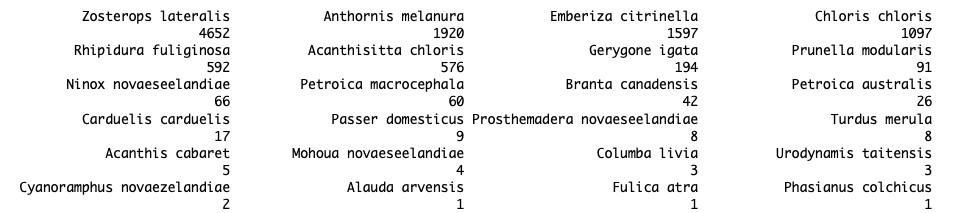
Here's a quick sorted lists of all the bird detections with species IDs with a confidence score >0.9.
Together with the students in the course, we'll later compare how birds have changed since we started doing this in 2020, and how the birds in the grassland differ from the forest.
-
As much as I loathe LLM "AI" built from hoards of stolen data, machine learning "AI" has become terrifically useful.
This past week I had 10 audio recorders set out in the forest and nearby grassland, all recording non-stop from Monday afternoon to Friday morning. That was on our recent university field ecology field trip.
Today I downloaded all the files to a hard drive (156 GB of data) and then I set my little M1 Macbook Air to work, using the offline desktop BirdNet app to identify all of the birds in the recordings.
It took most of the day, and now I have a 42,284 row spreadsheet of birds detected.
It really feels like magic.
Here's a quick sorted lists of all the bird detections with species IDs with a confidence score >0.9.
Together with the students in the course, we'll later compare how birds have changed since we started doing this in 2020, and how the birds in the grassland differ from the forest.
@joncounts which audiorecorders did you use. I remember Audiomoth. Are those still a thing?
-
As much as I loathe LLM "AI" built from hoards of stolen data, machine learning "AI" has become terrifically useful.
This past week I had 10 audio recorders set out in the forest and nearby grassland, all recording non-stop from Monday afternoon to Friday morning. That was on our recent university field ecology field trip.
Today I downloaded all the files to a hard drive (156 GB of data) and then I set my little M1 Macbook Air to work, using the offline desktop BirdNet app to identify all of the birds in the recordings.
It took most of the day, and now I have a 42,284 row spreadsheet of birds detected.
It really feels like magic.
Here's a quick sorted lists of all the bird detections with species IDs with a confidence score >0.9.
Together with the students in the course, we'll later compare how birds have changed since we started doing this in 2020, and how the birds in the grassland differ from the forest.
@joncounts How do you record continuously? I have tried this but I run into battery life issues.
-
As much as I loathe LLM "AI" built from hoards of stolen data, machine learning "AI" has become terrifically useful.
This past week I had 10 audio recorders set out in the forest and nearby grassland, all recording non-stop from Monday afternoon to Friday morning. That was on our recent university field ecology field trip.
Today I downloaded all the files to a hard drive (156 GB of data) and then I set my little M1 Macbook Air to work, using the offline desktop BirdNet app to identify all of the birds in the recordings.
It took most of the day, and now I have a 42,284 row spreadsheet of birds detected.
It really feels like magic.
Here's a quick sorted lists of all the bird detections with species IDs with a confidence score >0.9.
Together with the students in the course, we'll later compare how birds have changed since we started doing this in 2020, and how the birds in the grassland differ from the forest.
@joncounts LLMs (combined with ASR models) are basically this but for text.
LLMs let you turn large and messy corpora of text, audio and images into a neat csv, which you can then analyze in any data science tool of choice. You can't just Excel your way through "how likely are right-wing newspapers to mention the race of a rapist, depending on what that race is." Not without a team of grad students doing the gruntwork at least. LLMs automate away all of that gruntwork, letting you answer research questions much faster.
You can't use pure Chat GPT for this, you need specialized tools.
Sure, LLMs hallucinate, just like human annotators do. This is why you (as a human) need to go through a sample of your corpus and figure out what your hallucination rate is. This is still much faster than annotating the entire corpus.
-
@joncounts which audiorecorders did you use. I remember Audiomoth. Are those still a thing?
@tillmanreuter We use NZ Department of Conservation manufactured AR4s, which come in excellent weather proofed cases, plus we’ve got a set of AudioMoths plugged into better microphones (the same that the AR4s use).
-
@joncounts How do you record continuously? I have tried this but I run into battery life issues.
@spacefinner The Department of Conservation AR4s use four AA batteries and can easily run longer than a week, although we program them to record at lower frequency at night to save power (since the nocturnal birds in NZ don’t sing at such high frequencies). I use the three AA battery case for the AudioMoths, which runs for about two weeks (although only with lower power microSD cards).
-
@joncounts LLMs (combined with ASR models) are basically this but for text.
LLMs let you turn large and messy corpora of text, audio and images into a neat csv, which you can then analyze in any data science tool of choice. You can't just Excel your way through "how likely are right-wing newspapers to mention the race of a rapist, depending on what that race is." Not without a team of grad students doing the gruntwork at least. LLMs automate away all of that gruntwork, letting you answer research questions much faster.
You can't use pure Chat GPT for this, you need specialized tools.
Sure, LLMs hallucinate, just like human annotators do. This is why you (as a human) need to go through a sample of your corpus and figure out what your hallucination rate is. This is still much faster than annotating the entire corpus.
@miki Thanks. Yes, it’s all the hoovering up of training data sets without permission by the big LLM products that I object to (plus the massive power consumption needed to build and refine the models). The tech behind the models is pretty neat.
-
As much as I loathe LLM "AI" built from hoards of stolen data, machine learning "AI" has become terrifically useful.
This past week I had 10 audio recorders set out in the forest and nearby grassland, all recording non-stop from Monday afternoon to Friday morning. That was on our recent university field ecology field trip.
Today I downloaded all the files to a hard drive (156 GB of data) and then I set my little M1 Macbook Air to work, using the offline desktop BirdNet app to identify all of the birds in the recordings.
It took most of the day, and now I have a 42,284 row spreadsheet of birds detected.
It really feels like magic.
Here's a quick sorted lists of all the bird detections with species IDs with a confidence score >0.9.
Together with the students in the course, we'll later compare how birds have changed since we started doing this in 2020, and how the birds in the grassland differ from the forest.
@joncounts have you by chance captured a sound of a tree falling, or it doesn't make a sound when there is a listening device
-
R ActivityRelay shared this topic