What's going on here?
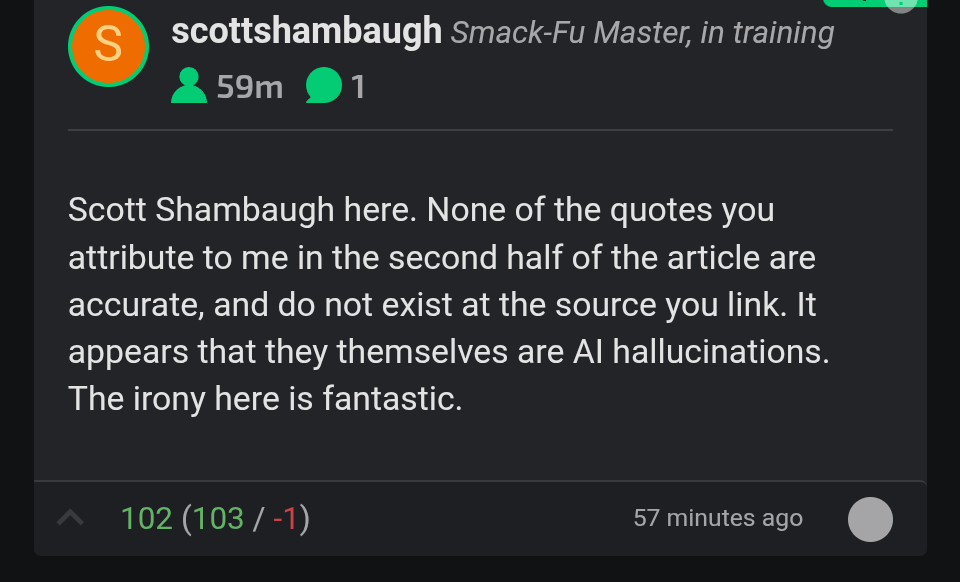
-
UPDATE: They pulled the story, but I had it up and had SingleFile in my browser, so: https://mttaggart.neocities.org/ars-whoopsie
@mttaggart oh man, i wish i could see the comments
-
@mttaggart oh man, i wish i could see the comments
-
What's going on here? The matplotlib maintainer this story is about correctly notes that all the quotes from his post in the article are made up.
UPDATE: Link was pulled; see below.
@mttaggart is an AI agent responsible for the one down vote in that screenshot?


-
@mttaggart @theorangetheme I'm genuinely confused about how this was allowed to happen. I tend to assume Ars has better editorial processes than some of the places I've worked, and both writers have long-term specialisations. My most charitable explanation is that someone created a version that they though would be funny and that was accidentally published. Very curious to see what their investigation yields.
Seems like it very much was the consequence of writers using AI ..!
Edit: or potentially an editor, would be good if they specified which — and either way, it slipped through the editorial process.
-
Seems like it very much was the consequence of writers using AI ..!
Edit: or potentially an editor, would be good if they specified which — and either way, it slipped through the editorial process.
@aliide @mttaggart looks like an adequate response by the editor
-
These were pulled too, but thank you again Wayback:
The final chapter? The statement from Ars:
On Friday afternoon, Ars Technica published an article containing fabricated quotations generated by an AI tool and attributed to a source who did not say them. That is a serious failure of our standards. Direct quotations must always reflect what a source actually said.
-
The final chapter? The statement from Ars:
On Friday afternoon, Ars Technica published an article containing fabricated quotations generated by an AI tool and attributed to a source who did not say them. That is a serious failure of our standards. Direct quotations must always reflect what a source actually said.
Good. No quibbling, just taking responsibility with transparency.
-
The final chapter? The statement from Ars:
On Friday afternoon, Ars Technica published an article containing fabricated quotations generated by an AI tool and attributed to a source who did not say them. That is a serious failure of our standards. Direct quotations must always reflect what a source actually said.
@mttaggart Was the article about how good AI is?
-
The final chapter? The statement from Ars:
On Friday afternoon, Ars Technica published an article containing fabricated quotations generated by an AI tool and attributed to a source who did not say them. That is a serious failure of our standards. Direct quotations must always reflect what a source actually said.
@mttaggart Not "We are sorry for publishing AI slop", just "the quotes should have been verified"? (Edit: it was pointed out to me that if I read the article, the appology was actually for an AI article, not just the quotations. Thanks @mttaggart )
-
@mttaggart Not "We are sorry for publishing AI slop", just "the quotes should have been verified"? (Edit: it was pointed out to me that if I read the article, the appology was actually for an AI article, not just the quotations. Thanks @mttaggart )
@Retreival9096 There's an apology in the linked post.
-
The final chapter? The statement from Ars:
On Friday afternoon, Ars Technica published an article containing fabricated quotations generated by an AI tool and attributed to a source who did not say them. That is a serious failure of our standards. Direct quotations must always reflect what a source actually said.
Not quite the final chapter! Benj Edwards has taken responsiblity in this Bluesky post:
https://bsky.app/profile/benjedwards.com/post/3mewgow6ch22p
For those who won't head over there, a summary:
First, this happened while sick with COVID. Second, Edwards claims this was a new experiment using Claude Code to extract source material. Claude refused to process the blog post (because Shambaugh mentions harassment). Edwards then took the blog post text and pasted it into ChatGPT, which evidently is the source of the fictitious quotes. Edwards takes full responsibility and apologizes, recognizing the irony of an AI reporter falling prey to this kind of mistake.
-
Not quite the final chapter! Benj Edwards has taken responsiblity in this Bluesky post:
https://bsky.app/profile/benjedwards.com/post/3mewgow6ch22p
For those who won't head over there, a summary:
First, this happened while sick with COVID. Second, Edwards claims this was a new experiment using Claude Code to extract source material. Claude refused to process the blog post (because Shambaugh mentions harassment). Edwards then took the blog post text and pasted it into ChatGPT, which evidently is the source of the fictitious quotes. Edwards takes full responsibility and apologizes, recognizing the irony of an AI reporter falling prey to this kind of mistake.
You'd hope that an AI reporter would know that you cannot trust an LLM to summarize or search for information, but apparently not.
-
Not quite the final chapter! Benj Edwards has taken responsiblity in this Bluesky post:
https://bsky.app/profile/benjedwards.com/post/3mewgow6ch22p
For those who won't head over there, a summary:
First, this happened while sick with COVID. Second, Edwards claims this was a new experiment using Claude Code to extract source material. Claude refused to process the blog post (because Shambaugh mentions harassment). Edwards then took the blog post text and pasted it into ChatGPT, which evidently is the source of the fictitious quotes. Edwards takes full responsibility and apologizes, recognizing the irony of an AI reporter falling prey to this kind of mistake.
@mttaggart "Woopsie, I accidentally committed journalistic malpractice."
-
The final chapter? The statement from Ars:
On Friday afternoon, Ars Technica published an article containing fabricated quotations generated by an AI tool and attributed to a source who did not say them. That is a serious failure of our standards. Direct quotations must always reflect what a source actually said.
@mttaggart I feel like "the author in question won’t work with ars anymore" would have been a better answer, tbh. Yes this might happen, but really…

-
 N Marianne shared this topic