Twelve years.
-
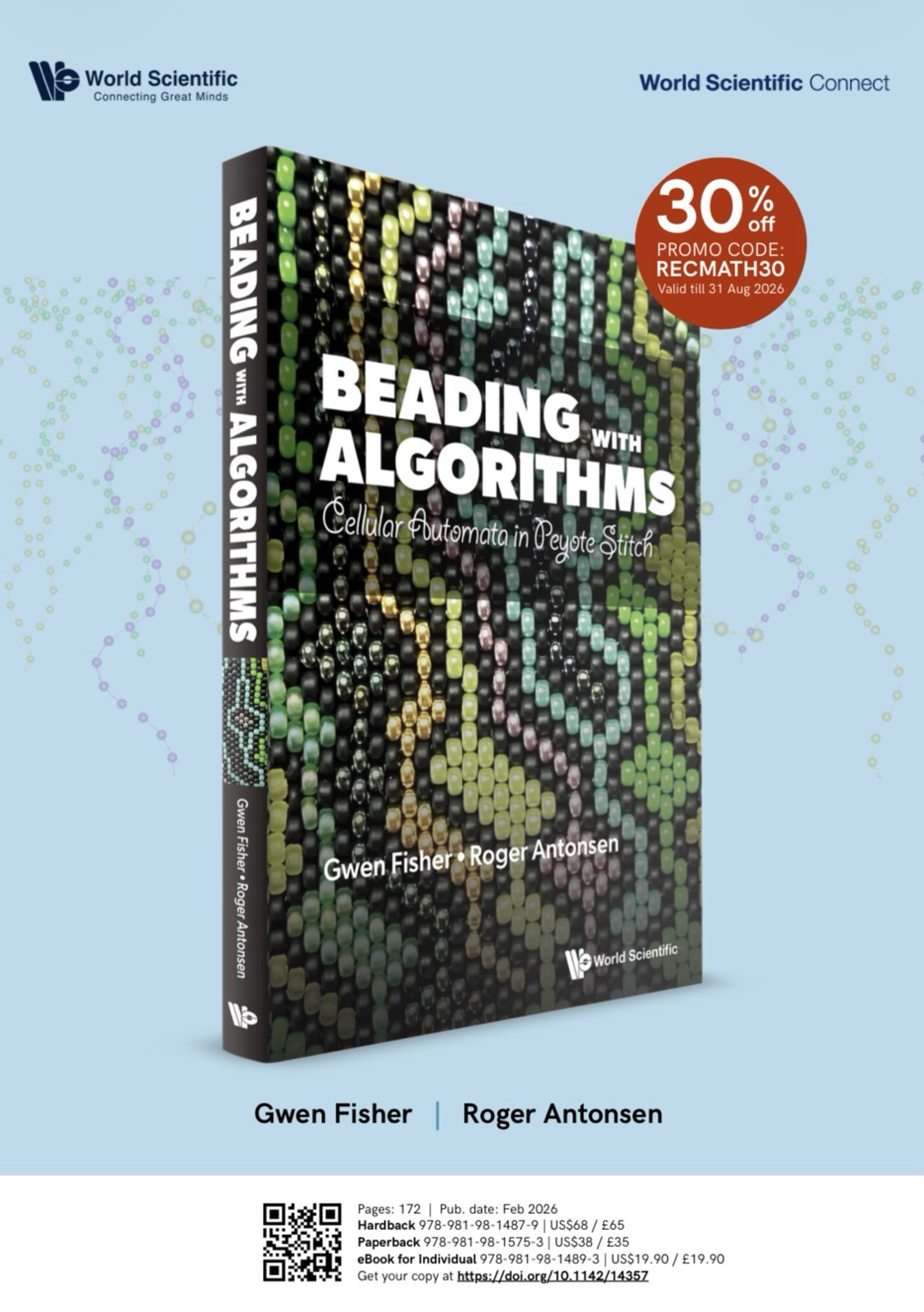
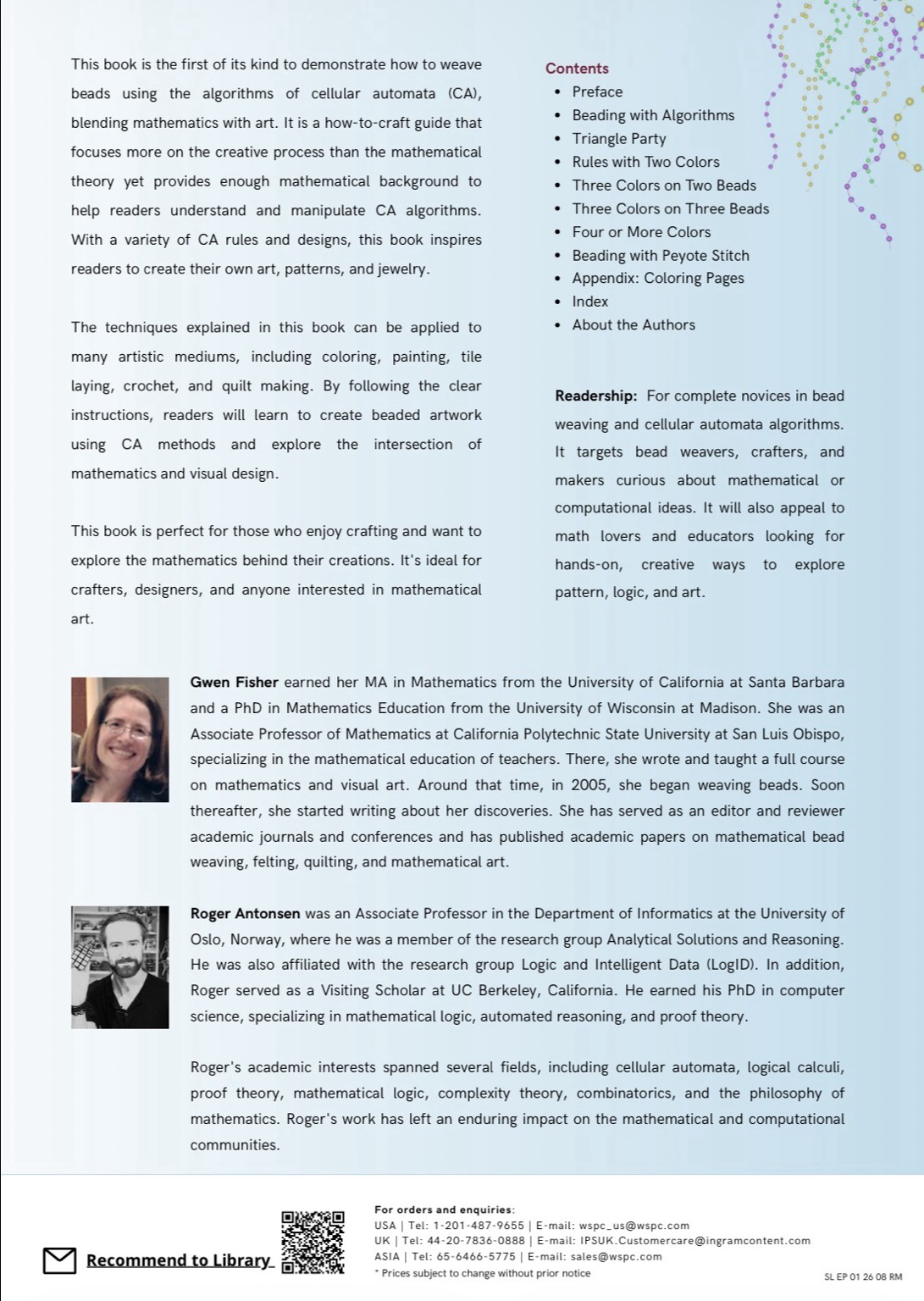
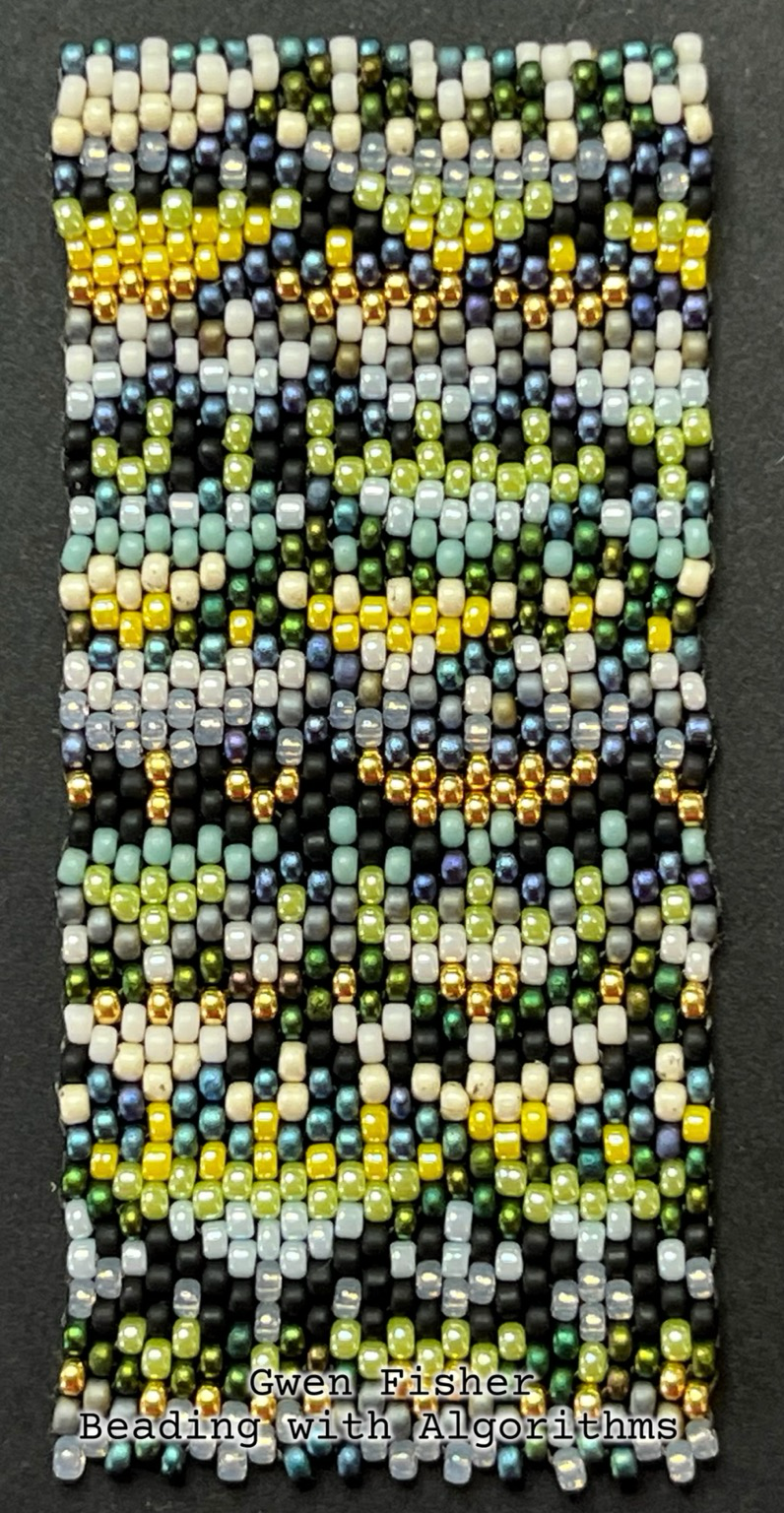
Twelve years. I started this project twelve years ago, and today I hold the result in my hand. It’s a book that combines bead weaving with math called, “Beading with Algorithms: Cellular Automata in Peyote Stitch.” With help from mathematician and artist Roger Antonsen, graphic designer Zelda Lin, a handful of talented proof readers, and the good people from World Scientific Publishing Company, my dream of combining my loves of math, art, and teaching into a book is finally a reality.
This book is the first of its kind, a recipe book of algorithms that can be used and combined to generate colorful patterns in peyote stitch beadwork in any size and shape you desire. These algorithms could also be applied to other pixelated art forms like tile laying, embroidery, crochet, and quilts. We included projects like bracelets, pill pouches, pendants, beaded beads, and key chains. We also included a bunch of different grids that you can photocopy and color with markers.
Of course I’m biased, but I think it’s a really beautiful book. We included multiple colorful images on almost every page, 172 pages in all. It was a huge layout challenge, but Zelda nailed it. My original goal was to write 128 pages on how to use algorithms to make beaded jewelry, but the more we explored the space, the more we found. Not just millions of algorithms, the space of possibilities is infinite. So of course, we couldn’t include them all. But we used math and Roger’s custom software that he wrote for this project to help us find dozens of the easiest algorithms and more than a hundred more in increasing levels of complexity. We included all of our favorites. 1/2
We found so much to include that the book ended up a full third longer than I had originally planned. It took years longer than I originally expected. But it was a labor of love, a passion project, something we made because we wanted to make something beautiful and inspiring. I can hardly believe it’s finally finished. I hope you will love it too.
Link to order the book: https://www.worldscientific.com/worldscibooks/10.1142/14357#t=aboutBook
There’s a 30% off code
RECMATH30It’s preorder. The release date is the end of February. 2/2
-
Twelve years. I started this project twelve years ago, and today I hold the result in my hand. It’s a book that combines bead weaving with math called, “Beading with Algorithms: Cellular Automata in Peyote Stitch.” With help from mathematician and artist Roger Antonsen, graphic designer Zelda Lin, a handful of talented proof readers, and the good people from World Scientific Publishing Company, my dream of combining my loves of math, art, and teaching into a book is finally a reality.
This book is the first of its kind, a recipe book of algorithms that can be used and combined to generate colorful patterns in peyote stitch beadwork in any size and shape you desire. These algorithms could also be applied to other pixelated art forms like tile laying, embroidery, crochet, and quilts. We included projects like bracelets, pill pouches, pendants, beaded beads, and key chains. We also included a bunch of different grids that you can photocopy and color with markers.
Of course I’m biased, but I think it’s a really beautiful book. We included multiple colorful images on almost every page, 172 pages in all. It was a huge layout challenge, but Zelda nailed it. My original goal was to write 128 pages on how to use algorithms to make beaded jewelry, but the more we explored the space, the more we found. Not just millions of algorithms, the space of possibilities is infinite. So of course, we couldn’t include them all. But we used math and Roger’s custom software that he wrote for this project to help us find dozens of the easiest algorithms and more than a hundred more in increasing levels of complexity. We included all of our favorites. 1/2
@gwenbeads not all algorithms are bad!


-
Twelve years. I started this project twelve years ago, and today I hold the result in my hand. It’s a book that combines bead weaving with math called, “Beading with Algorithms: Cellular Automata in Peyote Stitch.” With help from mathematician and artist Roger Antonsen, graphic designer Zelda Lin, a handful of talented proof readers, and the good people from World Scientific Publishing Company, my dream of combining my loves of math, art, and teaching into a book is finally a reality.
This book is the first of its kind, a recipe book of algorithms that can be used and combined to generate colorful patterns in peyote stitch beadwork in any size and shape you desire. These algorithms could also be applied to other pixelated art forms like tile laying, embroidery, crochet, and quilts. We included projects like bracelets, pill pouches, pendants, beaded beads, and key chains. We also included a bunch of different grids that you can photocopy and color with markers.
Of course I’m biased, but I think it’s a really beautiful book. We included multiple colorful images on almost every page, 172 pages in all. It was a huge layout challenge, but Zelda nailed it. My original goal was to write 128 pages on how to use algorithms to make beaded jewelry, but the more we explored the space, the more we found. Not just millions of algorithms, the space of possibilities is infinite. So of course, we couldn’t include them all. But we used math and Roger’s custom software that he wrote for this project to help us find dozens of the easiest algorithms and more than a hundred more in increasing levels of complexity. We included all of our favorites. 1/2
@gwenbeads congratulations Gwen!

 Exciting!
 -
We found so much to include that the book ended up a full third longer than I had originally planned. It took years longer than I originally expected. But it was a labor of love, a passion project, something we made because we wanted to make something beautiful and inspiring. I can hardly believe it’s finally finished. I hope you will love it too.
Link to order the book: https://www.worldscientific.com/worldscibooks/10.1142/14357#t=aboutBook
There’s a 30% off code
RECMATH30It’s preorder. The release date is the end of February. 2/2
@gwenbeads hi ya, just ordered it. Looking forward to it.
-
@gwenbeads hi ya, just ordered it. Looking forward to it.
@littlescraps thank you. I hope beading with algorithms brings you some of the joy it’s given me.
-
Twelve years. I started this project twelve years ago, and today I hold the result in my hand. It’s a book that combines bead weaving with math called, “Beading with Algorithms: Cellular Automata in Peyote Stitch.” With help from mathematician and artist Roger Antonsen, graphic designer Zelda Lin, a handful of talented proof readers, and the good people from World Scientific Publishing Company, my dream of combining my loves of math, art, and teaching into a book is finally a reality.
This book is the first of its kind, a recipe book of algorithms that can be used and combined to generate colorful patterns in peyote stitch beadwork in any size and shape you desire. These algorithms could also be applied to other pixelated art forms like tile laying, embroidery, crochet, and quilts. We included projects like bracelets, pill pouches, pendants, beaded beads, and key chains. We also included a bunch of different grids that you can photocopy and color with markers.
Of course I’m biased, but I think it’s a really beautiful book. We included multiple colorful images on almost every page, 172 pages in all. It was a huge layout challenge, but Zelda nailed it. My original goal was to write 128 pages on how to use algorithms to make beaded jewelry, but the more we explored the space, the more we found. Not just millions of algorithms, the space of possibilities is infinite. So of course, we couldn’t include them all. But we used math and Roger’s custom software that he wrote for this project to help us find dozens of the easiest algorithms and more than a hundred more in increasing levels of complexity. We included all of our favorites. 1/2
@gwenbeads Wow, that looks fascinating! First thing I've seen that makes me want to take up beading!
-
Twelve years. I started this project twelve years ago, and today I hold the result in my hand. It’s a book that combines bead weaving with math called, “Beading with Algorithms: Cellular Automata in Peyote Stitch.” With help from mathematician and artist Roger Antonsen, graphic designer Zelda Lin, a handful of talented proof readers, and the good people from World Scientific Publishing Company, my dream of combining my loves of math, art, and teaching into a book is finally a reality.
This book is the first of its kind, a recipe book of algorithms that can be used and combined to generate colorful patterns in peyote stitch beadwork in any size and shape you desire. These algorithms could also be applied to other pixelated art forms like tile laying, embroidery, crochet, and quilts. We included projects like bracelets, pill pouches, pendants, beaded beads, and key chains. We also included a bunch of different grids that you can photocopy and color with markers.
Of course I’m biased, but I think it’s a really beautiful book. We included multiple colorful images on almost every page, 172 pages in all. It was a huge layout challenge, but Zelda nailed it. My original goal was to write 128 pages on how to use algorithms to make beaded jewelry, but the more we explored the space, the more we found. Not just millions of algorithms, the space of possibilities is infinite. So of course, we couldn’t include them all. But we used math and Roger’s custom software that he wrote for this project to help us find dozens of the easiest algorithms and more than a hundred more in increasing levels of complexity. We included all of our favorites. 1/2
@gwenbeads this looks like a book that @standupmaths would take way too seriously, and then recruit some students to attempt a world record with
-
@littlescraps thank you. I hope beading with algorithms brings you some of the joy it’s given me.
@gwenbeads oh I think I am really going to have fun with it!
-
@gwenbeads Wow, that looks fascinating! First thing I've seen that makes me want to take up beading!
@MyYeeHaa thank you. Sure, you could take up beading; there’s a whole chapter on weaving beads. If that’s not your style, you could retile the bathroom or kitchen. The algorithms would work perfectly with ceramic tiles: squares, rectangles, or regular hexagons.
-
@gwenbeads this looks like a book that @standupmaths would take way too seriously, and then recruit some students to attempt a world record with
@MisterMadge @standupmaths perhaps the largest patch of 1D cellular automata that doesn’t repeat. I’d love to see it!
-
Twelve years. I started this project twelve years ago, and today I hold the result in my hand. It’s a book that combines bead weaving with math called, “Beading with Algorithms: Cellular Automata in Peyote Stitch.” With help from mathematician and artist Roger Antonsen, graphic designer Zelda Lin, a handful of talented proof readers, and the good people from World Scientific Publishing Company, my dream of combining my loves of math, art, and teaching into a book is finally a reality.
This book is the first of its kind, a recipe book of algorithms that can be used and combined to generate colorful patterns in peyote stitch beadwork in any size and shape you desire. These algorithms could also be applied to other pixelated art forms like tile laying, embroidery, crochet, and quilts. We included projects like bracelets, pill pouches, pendants, beaded beads, and key chains. We also included a bunch of different grids that you can photocopy and color with markers.
Of course I’m biased, but I think it’s a really beautiful book. We included multiple colorful images on almost every page, 172 pages in all. It was a huge layout challenge, but Zelda nailed it. My original goal was to write 128 pages on how to use algorithms to make beaded jewelry, but the more we explored the space, the more we found. Not just millions of algorithms, the space of possibilities is infinite. So of course, we couldn’t include them all. But we used math and Roger’s custom software that he wrote for this project to help us find dozens of the easiest algorithms and more than a hundred more in increasing levels of complexity. We included all of our favorites. 1/2
@gwenbeads Wow, congratulations!
-
@MyYeeHaa thank you. Sure, you could take up beading; there’s a whole chapter on weaving beads. If that’s not your style, you could retile the bathroom or kitchen. The algorithms would work perfectly with ceramic tiles: squares, rectangles, or regular hexagons.
-
@gwenbeads
Ordered!!@MyYeeHaa thank you so much. I hope it brings you some of the enjoyment that it’s brought me. I find the process of beading with algorithms (or even coloring with them) is very meditative. It’s good to calm an anxious mind.
-
Twelve years. I started this project twelve years ago, and today I hold the result in my hand. It’s a book that combines bead weaving with math called, “Beading with Algorithms: Cellular Automata in Peyote Stitch.” With help from mathematician and artist Roger Antonsen, graphic designer Zelda Lin, a handful of talented proof readers, and the good people from World Scientific Publishing Company, my dream of combining my loves of math, art, and teaching into a book is finally a reality.
This book is the first of its kind, a recipe book of algorithms that can be used and combined to generate colorful patterns in peyote stitch beadwork in any size and shape you desire. These algorithms could also be applied to other pixelated art forms like tile laying, embroidery, crochet, and quilts. We included projects like bracelets, pill pouches, pendants, beaded beads, and key chains. We also included a bunch of different grids that you can photocopy and color with markers.
Of course I’m biased, but I think it’s a really beautiful book. We included multiple colorful images on almost every page, 172 pages in all. It was a huge layout challenge, but Zelda nailed it. My original goal was to write 128 pages on how to use algorithms to make beaded jewelry, but the more we explored the space, the more we found. Not just millions of algorithms, the space of possibilities is infinite. So of course, we couldn’t include them all. But we used math and Roger’s custom software that he wrote for this project to help us find dozens of the easiest algorithms and more than a hundred more in increasing levels of complexity. We included all of our favorites. 1/2
@gwenbeads That looks great. I may have to order it; and I don’t even do beading!
-
Twelve years. I started this project twelve years ago, and today I hold the result in my hand. It’s a book that combines bead weaving with math called, “Beading with Algorithms: Cellular Automata in Peyote Stitch.” With help from mathematician and artist Roger Antonsen, graphic designer Zelda Lin, a handful of talented proof readers, and the good people from World Scientific Publishing Company, my dream of combining my loves of math, art, and teaching into a book is finally a reality.
This book is the first of its kind, a recipe book of algorithms that can be used and combined to generate colorful patterns in peyote stitch beadwork in any size and shape you desire. These algorithms could also be applied to other pixelated art forms like tile laying, embroidery, crochet, and quilts. We included projects like bracelets, pill pouches, pendants, beaded beads, and key chains. We also included a bunch of different grids that you can photocopy and color with markers.
Of course I’m biased, but I think it’s a really beautiful book. We included multiple colorful images on almost every page, 172 pages in all. It was a huge layout challenge, but Zelda nailed it. My original goal was to write 128 pages on how to use algorithms to make beaded jewelry, but the more we explored the space, the more we found. Not just millions of algorithms, the space of possibilities is infinite. So of course, we couldn’t include them all. But we used math and Roger’s custom software that he wrote for this project to help us find dozens of the easiest algorithms and more than a hundred more in increasing levels of complexity. We included all of our favorites. 1/2
@toxi You might enjoy this book!
-
@gwenbeads That looks great. I may have to order it; and I don’t even do beading!
@UweHalfHand thank you. It’s a pretty book full of pretty pictures. Maybe that’s enough. One of my goals was to make it pass “the flip test,” meaning when you quickly flip through the pages, there’s an explosion of colorful images. When I’m in bookstores, I always use the flip test when deciding which books to buy for myself because I like pictures more than text.
There’s a complete chapter on bead weaving, but if you don’t want to learn beading, you could color the coloring pages. It’s very meditative. Or maybe you know how to lay tile, and you could use the algorithms to tile the bathroom or kitchen. The algorithms all work with grids using squares, rectangles, or regular hexagons.
-
Twelve years. I started this project twelve years ago, and today I hold the result in my hand. It’s a book that combines bead weaving with math called, “Beading with Algorithms: Cellular Automata in Peyote Stitch.” With help from mathematician and artist Roger Antonsen, graphic designer Zelda Lin, a handful of talented proof readers, and the good people from World Scientific Publishing Company, my dream of combining my loves of math, art, and teaching into a book is finally a reality.
This book is the first of its kind, a recipe book of algorithms that can be used and combined to generate colorful patterns in peyote stitch beadwork in any size and shape you desire. These algorithms could also be applied to other pixelated art forms like tile laying, embroidery, crochet, and quilts. We included projects like bracelets, pill pouches, pendants, beaded beads, and key chains. We also included a bunch of different grids that you can photocopy and color with markers.
Of course I’m biased, but I think it’s a really beautiful book. We included multiple colorful images on almost every page, 172 pages in all. It was a huge layout challenge, but Zelda nailed it. My original goal was to write 128 pages on how to use algorithms to make beaded jewelry, but the more we explored the space, the more we found. Not just millions of algorithms, the space of possibilities is infinite. So of course, we couldn’t include them all. But we used math and Roger’s custom software that he wrote for this project to help us find dozens of the easiest algorithms and more than a hundred more in increasing levels of complexity. We included all of our favorites. 1/2
@gwenbeads Funny how life aligns sometimes
I am currently listening to "The Fabric of Civilization" by Virginia Postrel, which goes into the math/algorithm side of weaving at length.
There is some theorizing that some of the earliest advances in math stemmed from weaving. Basic concepts recorded for the first time, like rules about even and odd numbers, prime numbers etc. All necessary fundamentals needed for the successful weaving of patterns.
-
We found so much to include that the book ended up a full third longer than I had originally planned. It took years longer than I originally expected. But it was a labor of love, a passion project, something we made because we wanted to make something beautiful and inspiring. I can hardly believe it’s finally finished. I hope you will love it too.
Link to order the book: https://www.worldscientific.com/worldscibooks/10.1142/14357#t=aboutBook
There’s a 30% off code
RECMATH30It’s preorder. The release date is the end of February. 2/2
@gwenbeads @GinevraCat Can't wait for my copy!!! Congratulations - this looks amazing!
-
@gwenbeads Funny how life aligns sometimes
I am currently listening to "The Fabric of Civilization" by Virginia Postrel, which goes into the math/algorithm side of weaving at length.
There is some theorizing that some of the earliest advances in math stemmed from weaving. Basic concepts recorded for the first time, like rules about even and odd numbers, prime numbers etc. All necessary fundamentals needed for the successful weaving of patterns.
@sewblue yes, weaving and computing are longtime friends. It’s arguable that the first computing machines are looms. Cellular automata are special types of algorithms though because depending upon how you start, you can get many different patterns out of one algorithm. In contrast, with a punchcard loom, you’re always going to get more or less the same pattern, although you can still change the colors and dimensions.
-
@gwenbeads @GinevraCat Can't wait for my copy!!! Congratulations - this looks amazing!
@RosyMaths @GinevraCat thank you so much Rosy. I hope you find a similar joy to what I have from beading with algorithms. It’s very meditative.