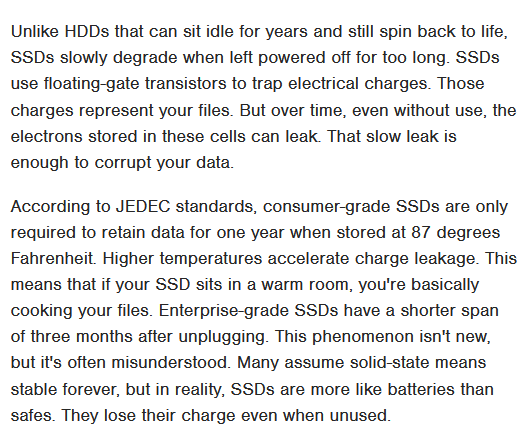
TIL that SSDs can lose data if left unplugged for long periods of time (only required to hold data up to 1 year), unlike HDDs which as long as the material holds it can take years.
-
@djlink Yeah, I've finally got around to the process of making iso clones of all of my old DVDs so I can throw them out and I'm doing a 2-tier approach with SSD for convenience and cheap stable HDD for long term.
Also worth noting that HDDs are better at detecting problems before it's too late.
@dpiponi it's possible my PS4 slow HDD might outlive the PS5 fast SSD xD
-
TIL that SSDs can lose data if left unplugged for long periods of time (only required to hold data up to 1 year), unlike HDDs which as long as the material holds it can take years.
Edit: added link: https://www.slashgear.com/1893447/dont-leave-your-old-ssd-unplugged/
@djlink don't ask about post-N64 Nintendo cartridges.
-
@djlink don't ask about post-N64 Nintendo cartridges.
-
TIL that SSDs can lose data if left unplugged for long periods of time (only required to hold data up to 1 year), unlike HDDs which as long as the material holds it can take years.
Edit: added link: https://www.slashgear.com/1893447/dont-leave-your-old-ssd-unplugged/
@djlink Short State Drive

-
TIL that SSDs can lose data if left unplugged for long periods of time (only required to hold data up to 1 year), unlike HDDs which as long as the material holds it can take years.
Edit: added link: https://www.slashgear.com/1893447/dont-leave-your-old-ssd-unplugged/
@djlink on topic: I’ve today plugged in a Compact Flash card that hasn’t been powered in more than 3 years.
Perfect data retention.
Took a quick dd image of it, just in case.
-
TIL that SSDs can lose data if left unplugged for long periods of time (only required to hold data up to 1 year), unlike HDDs which as long as the material holds it can take years.
Edit: added link: https://www.slashgear.com/1893447/dont-leave-your-old-ssd-unplugged/
@djlink@mastodon.gamedev.place it's great that your alt text has a transcription of the screenshotted text (thank you!), but the link at the end ought to be in your post body, not the image alt text. it's easy to miss because you don't mention the link and not everyone opens the alt text, but on some frontends it is difficult or impossible to select/copy from/open links in the alt text.
-
@djlink@mastodon.gamedev.place it's great that your alt text has a transcription of the screenshotted text (thank you!), but the link at the end ought to be in your post body, not the image alt text. it's easy to miss because you don't mention the link and not everyone opens the alt text, but on some frontends it is difficult or impossible to select/copy from/open links in the alt text.
@sodiboo sorry about that, thanks for posting it for me

-
TIL that SSDs can lose data if left unplugged for long periods of time (only required to hold data up to 1 year), unlike HDDs which as long as the material holds it can take years.
Edit: added link: https://www.slashgear.com/1893447/dont-leave-your-old-ssd-unplugged/
@djlink I mean yea, but both are not ok for archiving, you actually want them in a live enclosure, preffereably with redundancy
-
@sodiboo sorry about that, thanks for posting it for me
-
TIL that SSDs can lose data if left unplugged for long periods of time (only required to hold data up to 1 year), unlike HDDs which as long as the material holds it can take years.
Edit: added link: https://www.slashgear.com/1893447/dont-leave-your-old-ssd-unplugged/
@djlink IMO the only material proven to hold digital data for decades at this point is tape, as evidenced by the tape reels they keep finding in storage warehouses whose contents are successfully read back https://www.tomshardware.com/software/linux/recovered-unix-v4-tape-quickly-yields-a-usable-operating-system-nostalgia-addicts-can-now-boot-up-unix-v4-in-a-browser-window
I suppose HDDs can hold archival data, but there are way more ways for spinning discs to fail than tape when stored for long periods of time. But maybe we can use magnetic microscopy to recover their data even if their circuits have died, their motors have failed, or their lubricants have died out. https://garnerproducts.com/hubfs/ucsd_recovery_of_partially_degaussed-hdds.pdf
-
TIL that SSDs can lose data if left unplugged for long periods of time (only required to hold data up to 1 year), unlike HDDs which as long as the material holds it can take years.
Edit: added link: https://www.slashgear.com/1893447/dont-leave-your-old-ssd-unplugged/
@djlink Interesting. I use HDDs for my backups. Sounds like I should continue to do so.
-
TIL that SSDs can lose data if left unplugged for long periods of time (only required to hold data up to 1 year), unlike HDDs which as long as the material holds it can take years.
Edit: added link: https://www.slashgear.com/1893447/dont-leave-your-old-ssd-unplugged/
@djlink that is a very poor-quality source; modern SSDs indeed hold data for years, and powering them also doesn't increase data retention; they're not in any technical sense related to static (which needs constant power, very little) or dynamic RAM (which needs refresh cycles every few milliseconds).
You can be pretty certain that a not end-of-write-life SSD will retain data for years to decades. If you care, some SSDs actually specify more than just a overall MTBF (often in the 10⁶ h) -
@djlink IMO the only material proven to hold digital data for decades at this point is tape, as evidenced by the tape reels they keep finding in storage warehouses whose contents are successfully read back https://www.tomshardware.com/software/linux/recovered-unix-v4-tape-quickly-yields-a-usable-operating-system-nostalgia-addicts-can-now-boot-up-unix-v4-in-a-browser-window
I suppose HDDs can hold archival data, but there are way more ways for spinning discs to fail than tape when stored for long periods of time. But maybe we can use magnetic microscopy to recover their data even if their circuits have died, their motors have failed, or their lubricants have died out. https://garnerproducts.com/hubfs/ucsd_recovery_of_partially_degaussed-hdds.pdf
@drahardja they don’t make tech as they used to xD
-
@djlink that is a very poor-quality source; modern SSDs indeed hold data for years, and powering them also doesn't increase data retention; they're not in any technical sense related to static (which needs constant power, very little) or dynamic RAM (which needs refresh cycles every few milliseconds).
You can be pretty certain that a not end-of-write-life SSD will retain data for years to decades. If you care, some SSDs actually specify more than just a overall MTBF (often in the 10⁶ h)@djlink I'm not even sure where the myth that powering on helps data retention comes from; the last thing an SSD would want to do to increase data reliability would be doing any writing in the background.
-
@drahardja they don’t make tech as they used to xD
@djlink Heh heh, I know you’re joking, but I think the engineering balance has shifted. We want faster access, higher data density, smaller sizes, and fewer moving parts. Data longevity beyond 1–3 years of non-use is not even a selling factor any more.
-
TIL that SSDs can lose data if left unplugged for long periods of time (only required to hold data up to 1 year), unlike HDDs which as long as the material holds it can take years.
Edit: added link: https://www.slashgear.com/1893447/dont-leave-your-old-ssd-unplugged/
@djlink thank you for the reminder to plug in my backup drive
-
TIL that SSDs can lose data if left unplugged for long periods of time (only required to hold data up to 1 year), unlike HDDs which as long as the material holds it can take years.
Edit: added link: https://www.slashgear.com/1893447/dont-leave-your-old-ssd-unplugged/
@djlink i grew up thinking that the data stored in drives was permanent, but then quickly learned about the unfortunate reality of entropy

-
@djlink I'm not even sure where the myth that powering on helps data retention comes from; the last thing an SSD would want to do to increase data reliability would be doing any writing in the background.
@djlink note that yes, there's JESD218, but that specifies a lower limit (and indeed 1 a) for powered off data retention at the point in time when your SSD has reached its specified write volume; yes, electrons tunnel out of flash cells' gate capacitors, but as long as you've not written these to the end of their capacitance (erasing&rewriting makes these capacitors worse), this can all be accounted for by the SSD itself.
(the powering off is not a penalty to the SSD! Just the test condition!) -
@djlink IMO the only material proven to hold digital data for decades at this point is tape, as evidenced by the tape reels they keep finding in storage warehouses whose contents are successfully read back https://www.tomshardware.com/software/linux/recovered-unix-v4-tape-quickly-yields-a-usable-operating-system-nostalgia-addicts-can-now-boot-up-unix-v4-in-a-browser-window
I suppose HDDs can hold archival data, but there are way more ways for spinning discs to fail than tape when stored for long periods of time. But maybe we can use magnetic microscopy to recover their data even if their circuits have died, their motors have failed, or their lubricants have died out. https://garnerproducts.com/hubfs/ucsd_recovery_of_partially_degaussed-hdds.pdf
@drahardja @djlink tape storage has its own risks due to the fact it's exposed to the elements. I've heard of cases where audio tape gets mouldy, flaky, sticky, magnetised / demagnetised, disintegrates, unrolls, crinkles, etc.
-
@drahardja @djlink tape storage has its own risks due to the fact it's exposed to the elements. I've heard of cases where audio tape gets mouldy, flaky, sticky, magnetised / demagnetised, disintegrates, unrolls, crinkles, etc.