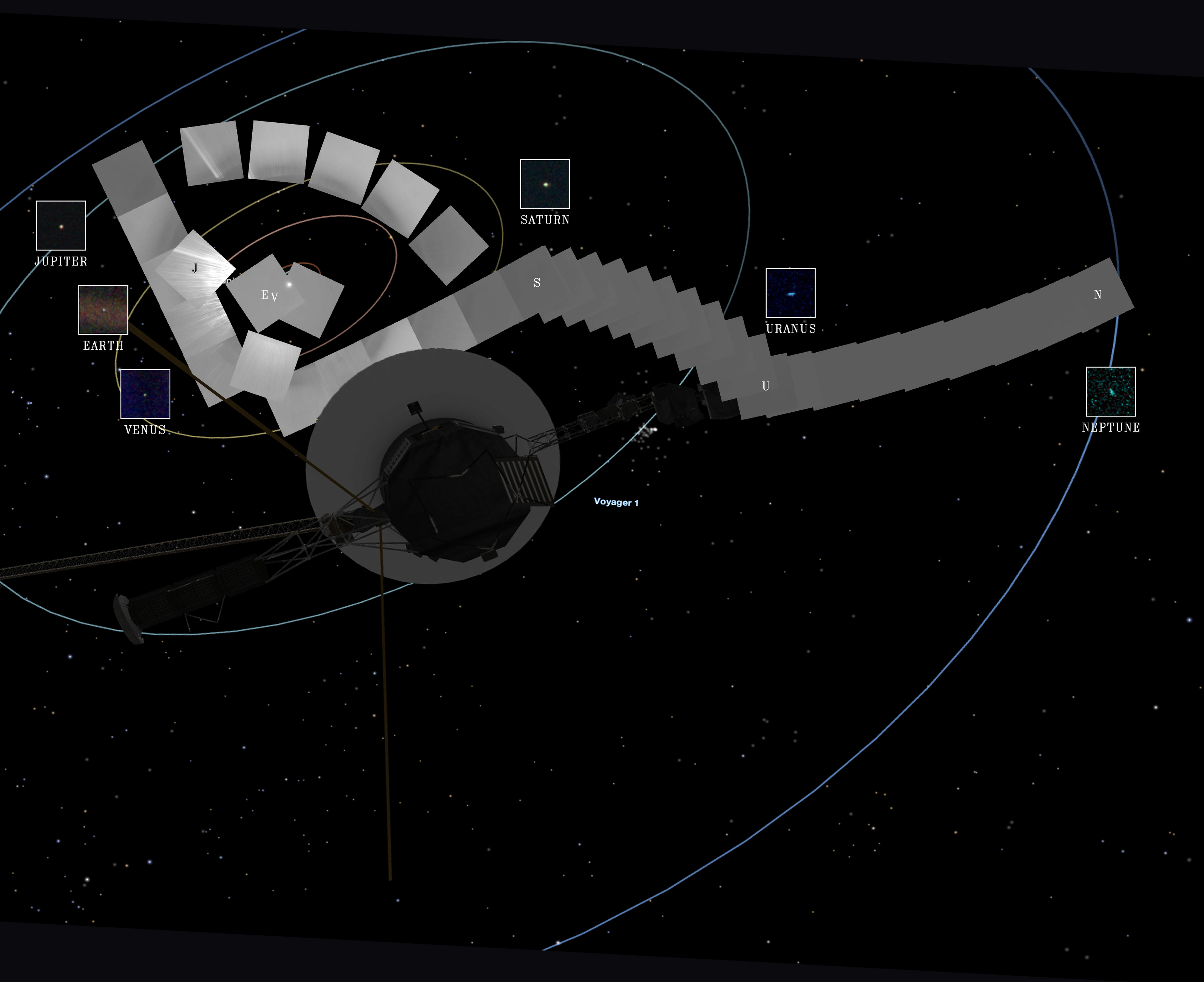
The "Pale Blue Dot" image was part of the "Family Portrait" set of images taken by Voyager 1 on Feb 14, 1990, from a vantage point 6 billion km away and ~32° above the ecliptic.
-
The "Pale Blue Dot" image was part of the "Family Portrait" set of images taken by Voyager 1 on Feb 14, 1990, from a vantage point 6 billion km away and ~32° above the ecliptic.
Starting at 01:00 UTC after a 3 hour warm-up, Voyager 1's cameras imaged Neptune, Uranus, Saturn, Mars, the Sun, and then Jupiter, Earth, and Venus. The Earth images were taken at 04:48 UTC. The cameras were turned off permanently at 05:22.
Image data download was completed on May 1, 1990.
https://science.nasa.gov/mission/voyager/voyager-1s-pale-blue-dot/
1/n -
The "Pale Blue Dot" image was part of the "Family Portrait" set of images taken by Voyager 1 on Feb 14, 1990, from a vantage point 6 billion km away and ~32° above the ecliptic.
Starting at 01:00 UTC after a 3 hour warm-up, Voyager 1's cameras imaged Neptune, Uranus, Saturn, Mars, the Sun, and then Jupiter, Earth, and Venus. The Earth images were taken at 04:48 UTC. The cameras were turned off permanently at 05:22.
Image data download was completed on May 1, 1990.
https://science.nasa.gov/mission/voyager/voyager-1s-pale-blue-dot/
1/nSagan and other members of the Voyager team felt the images were needed — they wanted humanity to see Earth’s vulnerability, and that our home world is just a tiny, fragile speck in the cosmic ocean.
JPL mounted the entire 20-foot mosaic on a wall in its Theodore von Kármán Auditorium.
"Members of the Voyager imaging team said in a 2019 research paper that the image of Earth on the wall had to be replaced often because so many people touched it."
🥲
https://science.nasa.gov/mission/voyager/voyager-1s-pale-blue-dot/
2/n -
R ActivityRelay shared this topic