If you have to put up a sign asking cyclists to please use your shared pedestrian path, you've designed it wrong.
-
If you have to put up a sign asking cyclists to please use your shared pedestrian path, you've designed it wrong.
As a commuter cyclist, I want to get from point A to point B as fast as I can, without dying. Just like a car driver.
When given the option of riding on the road verge, or weaving in and out of people walking their dogs with headphones on and children walking to school and friends walking along chatting to each other, and giving way to cars at every little side road, then I choose the road verge. So do people on road bikes zipping past me at >30 km/hr.
I really like the separated cycleways that Christchurch city has built. They're safe and fast and well used.
I worry about the recent proliferation instead of "shared paths" in new road developments which combine cyclists with pedestrians and discourage bikes from being on the road at all.
Shared paths are useful for children on bikes, if we teach them how to ride around pedestrians, but they're impractical for an adult cyclist trying to travel 20–30 km/hr.
Please, let's keep investing in separated cycleways for cycle commuters. That's what will get more commuters out of cars, not shared paths.
@joncounts Bikes at ~20Km/h mix far better with cars at ~40Km/h than with pedestrians at ~5Km/h. Shared paths are dangerous and a nuisance, except where they're rarely used.
I mean, locally, there is one 900 metre length of shared path on which you rarely encounter any other users, and I sometimes use that; but generally, the road feels safer and is faster.
-
If you have to put up a sign asking cyclists to please use your shared pedestrian path, you've designed it wrong.
As a commuter cyclist, I want to get from point A to point B as fast as I can, without dying. Just like a car driver.
When given the option of riding on the road verge, or weaving in and out of people walking their dogs with headphones on and children walking to school and friends walking along chatting to each other, and giving way to cars at every little side road, then I choose the road verge. So do people on road bikes zipping past me at >30 km/hr.
I really like the separated cycleways that Christchurch city has built. They're safe and fast and well used.
I worry about the recent proliferation instead of "shared paths" in new road developments which combine cyclists with pedestrians and discourage bikes from being on the road at all.
Shared paths are useful for children on bikes, if we teach them how to ride around pedestrians, but they're impractical for an adult cyclist trying to travel 20–30 km/hr.
Please, let's keep investing in separated cycleways for cycle commuters. That's what will get more commuters out of cars, not shared paths.
@joncounts As a pedestrian, I dislike shared paths. Cyclists zooming next to me from behind; if I trip or decide to change directions it may end up as a collision.
-
@joncounts Bikes at ~20Km/h mix far better with cars at ~40Km/h than with pedestrians at ~5Km/h. Shared paths are dangerous and a nuisance, except where they're rarely used.
I mean, locally, there is one 900 metre length of shared path on which you rarely encounter any other users, and I sometimes use that; but generally, the road feels safer and is faster.
@simon_brooke Yes, that's my approach too. I'll use shared paths when there are hardly any pedestrians on them, or when the road is stupidly dangerous. Otherwise, I tend to zip along using the road verge.
-
@joncounts As a pedestrian, I dislike shared paths. Cyclists zooming next to me from behind; if I trip or decide to change directions it may end up as a collision.
@ojala Yes, I get that too. I try to be polite and slow down and let pedestrians know I'm coming. Whatever I say some of them get startled. And, there's all the pedestrians with airpods in that don't hear me coming whatever I say. And when they're walking dogs on leads, it gets tricky to get around them.
Shared paths seem like a solution designed by car drivers for car drivers.
-
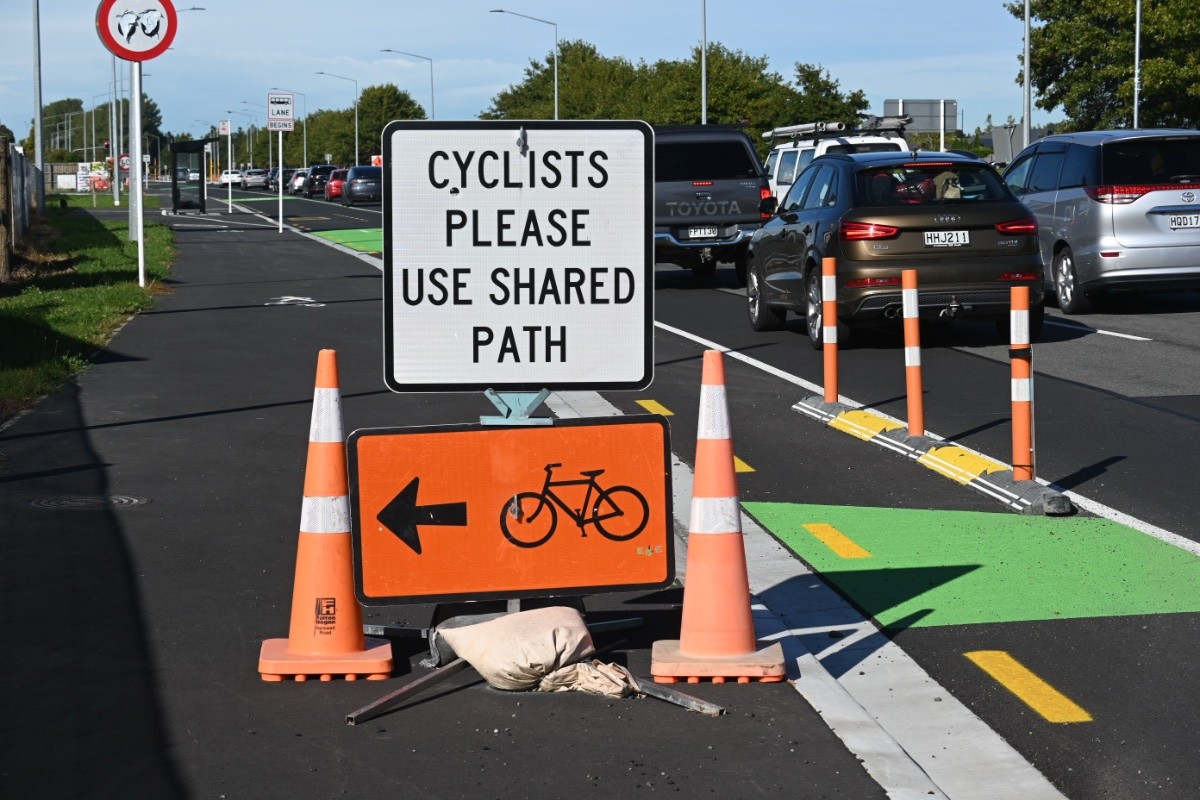
The new shared path in my photo runs along what is about to be a big new housing subdivision in Halswell. It's pretty empty now, but the houses are just starting to be built so soon there will be lots of pedestrians using it. There's a designated bus lane now, which is clever, but it means there's no longer space anywhere on the road for a cyclist.
@joncounts I’m confused by the photo that just seems to be a construction/temporary sign and the road paint which seems to show a dedicated bike lane (*with bollards!*)
-
@simon_brooke Yes, that's my approach too. I'll use shared paths when there are hardly any pedestrians on them, or when the road is stupidly dangerous. Otherwise, I tend to zip along using the road verge.
@joncounts I prefer to stay in primary position except where the traffic is congested enough to be slow, or else light enough that there are clear sightlines. Keeping in to the side of the road invites drivers to pass you close, which is dangerous.
However, it has to be said that here (Scotland) driving standards have improved remarkably over the past fifteen years, and it's now rare that a driver will pass you in the same lane, which makes riding on the road much better...
-
@joncounts I’m confused by the photo that just seems to be a construction/temporary sign and the road paint which seems to show a dedicated bike lane (*with bollards!*)
@mez That allows the bikes to get up onto the shared path before the lane turns into a designated bus lane.
-
If you have to put up a sign asking cyclists to please use your shared pedestrian path, you've designed it wrong.
As a commuter cyclist, I want to get from point A to point B as fast as I can, without dying. Just like a car driver.
When given the option of riding on the road verge, or weaving in and out of people walking their dogs with headphones on and children walking to school and friends walking along chatting to each other, and giving way to cars at every little side road, then I choose the road verge. So do people on road bikes zipping past me at >30 km/hr.
I really like the separated cycleways that Christchurch city has built. They're safe and fast and well used.
I worry about the recent proliferation instead of "shared paths" in new road developments which combine cyclists with pedestrians and discourage bikes from being on the road at all.
Shared paths are useful for children on bikes, if we teach them how to ride around pedestrians, but they're impractical for an adult cyclist trying to travel 20–30 km/hr.
Please, let's keep investing in separated cycleways for cycle commuters. That's what will get more commuters out of cars, not shared paths.
@joncounts The separate of cyclists and pedestrians by the museum is one of the best changes to cycleways. Even with students going to school who were quite aware of bike commuters, it was hard on everyone when it was shared.
And the split paths by Parakiore is probably the best block of transport in the country.
-
@joncounts I prefer to stay in primary position except where the traffic is congested enough to be slow, or else light enough that there are clear sightlines. Keeping in to the side of the road invites drivers to pass you close, which is dangerous.
However, it has to be said that here (Scotland) driving standards have improved remarkably over the past fifteen years, and it's now rare that a driver will pass you in the same lane, which makes riding on the road much better...
@joncounts Two years ago I was complaining that drivers would pass wide -- in the oncoming traffic lane -- even when approaching a blind bend, which is MAD; that does still happen but now it's becoming much more common for drivers to slow down and wait behind me until they can see the road is clear (or until I signal them past).
I think this is because there are more cyclists on the road, but it's a very good thing and I'm grateful for it.
-
@joncounts The separate of cyclists and pedestrians by the museum is one of the best changes to cycleways. Even with students going to school who were quite aware of bike commuters, it was hard on everyone when it was shared.
And the split paths by Parakiore is probably the best block of transport in the country.
@mez Yes, I agree. The separation by the museum is fastastic! It's much easier for pedestrians and cyclists when there are two streams right next to each other instead of an often chaotic mix.
-
@joncounts I prefer to stay in primary position except where the traffic is congested enough to be slow, or else light enough that there are clear sightlines. Keeping in to the side of the road invites drivers to pass you close, which is dangerous.
However, it has to be said that here (Scotland) driving standards have improved remarkably over the past fifteen years, and it's now rare that a driver will pass you in the same lane, which makes riding on the road much better...
@simon_brooke
Oh, that just sounds like a dream. We aren't there yet in Aotearoa. I get grief for using a whole lane even when there are two in the direction of travel.and the other one is empty
@joncounts -
@joncounts Two years ago I was complaining that drivers would pass wide -- in the oncoming traffic lane -- even when approaching a blind bend, which is MAD; that does still happen but now it's becoming much more common for drivers to slow down and wait behind me until they can see the road is clear (or until I signal them past).
I think this is because there are more cyclists on the road, but it's a very good thing and I'm grateful for it.
@simon_brooke Drivers here in NZ still regularly do crazy stunts like that, passing cyclists on blind bends without slowing down, or passing cyclists causing oncoming traffic to brake (which is insane!!). It happens often enough on my bike ride to work that I've started to note it down each time it happens. It's typically once or twice a fortnight.
(I've been keeping track of it to get the numbers to test whether drivers in big utes are more likely to do this than drivers in smaller cars, which is my impression so far.)
I'm hoping we follow your example and this kind of dangerous driving drops as the number of people cycling continues to rise and more car drivers figure out how to drive safely near cyclists.
-
@simon_brooke
Oh, that just sounds like a dream. We aren't there yet in Aotearoa. I get grief for using a whole lane even when there are two in the direction of travel.and the other one is empty
@joncounts@RedRobyn @joncounts It wasn't always this way! Like I say, fifteen years ago things were very different.
I'm not sure what's been the main cause of change. I've not been aware of very strong 'public information' campaigns. But more people are cycling, and, with electric bikes, more people are cycling in 'ordinary clothes'.
Roads around here are mostly 60MPH (~100km/h) speed limit, but cycling on them is now mostly pleasant and very rarely frightening.
-
@RedRobyn @joncounts It wasn't always this way! Like I say, fifteen years ago things were very different.
I'm not sure what's been the main cause of change. I've not been aware of very strong 'public information' campaigns. But more people are cycling, and, with electric bikes, more people are cycling in 'ordinary clothes'.
Roads around here are mostly 60MPH (~100km/h) speed limit, but cycling on them is now mostly pleasant and very rarely frightening.
@simon_brooke
I suspect I will be past comfortable cycling age before that happens here, especially on the rural roads with thr higher speed limits. Mostly that's 100km/hr, maybe a shade above 60mph, but if you drive at the limit you get an impatient queue behind you pretty quickly. Most of those are 1 lane each way with a 4 inch wide strip of paint between them, and a narrow (or non-existent) hard shoulder. I don't honestly know if I would have the confidence to ride those roads. It's the urban roads with a 50 km/hr limit (about 30mph) which I'm mostly riding.
@joncounts -
R ActivityRelay shared this topic