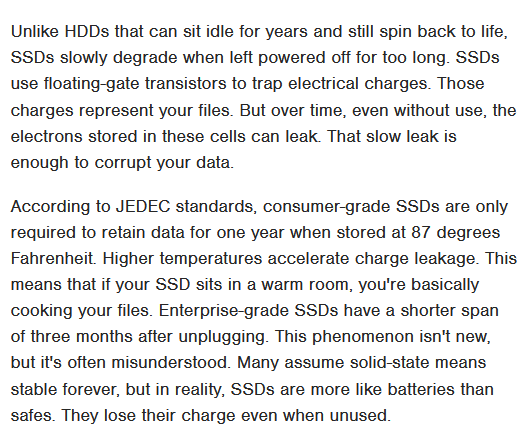
TIL that SSDs can lose data if left unplugged for long periods of time (only required to hold data up to 1 year), unlike HDDs which as long as the material holds it can take years.
-
TIL that SSDs can lose data if left unplugged for long periods of time (only required to hold data up to 1 year), unlike HDDs which as long as the material holds it can take years.
Edit: added link: https://www.slashgear.com/1893447/dont-leave-your-old-ssd-unplugged/
@djlink@mastodon.gamedev.place Wow Enterprise SSDs are even worse in retaining data.
Though that makes sense, too. -
@raymaccarthy @djlink yeah, sure
-
TIL that SSDs can lose data if left unplugged for long periods of time (only required to hold data up to 1 year), unlike HDDs which as long as the material holds it can take years.
Edit: added link: https://www.slashgear.com/1893447/dont-leave-your-old-ssd-unplugged/
@djlink Don't HDDs still lose some of the magnetism over time even while the media is good? And you can't just plug it back in to fix that either. You have to rewrite the data.
I don't know about the standards only requiring SSDs to last one year. I guess it varies by device and manufacturer, but I have never seen a solid state storage device lose data remotely close to that quickly. I've never actually had any of mine lose data just in a normal lifetime of normal usage. Heck, my old 128MB USB flash drive that I used on my PS2 still works and I haven't even plugged that in in something like ten years. (Dust bunnies galore!) I recently turned on my even older Cowon D2 DAP (like a MP3 player but can do videos) and it still worked after more than 10 years... (I think it's NAND.)
-
TIL that SSDs can lose data if left unplugged for long periods of time (only required to hold data up to 1 year), unlike HDDs which as long as the material holds it can take years.
Edit: added link: https://www.slashgear.com/1893447/dont-leave-your-old-ssd-unplugged/
@djlink This claim pops up from time to time and has for a damn decade. https://www.pcworld.com/article/427602/debunked-your-ssd-wont-lose-data-if-left-unplugged-after-all.html
-
TIL that SSDs can lose data if left unplugged for long periods of time (only required to hold data up to 1 year), unlike HDDs which as long as the material holds it can take years.
Edit: added link: https://www.slashgear.com/1893447/dont-leave-your-old-ssd-unplugged/
@djlink Same goes for SD Cards and similar. :3 -
@raymaccarthy @djlink I honestly find the opposite to be the case - HDDs can expose mechanical degradations (air barriers, motor bearings) that tend to work against you when you leave them unpowered. But this isn't about HDDs; it's about the myth that powering on an SSD will help data retention.
@funkylab @raymaccarthy @djlink Nice SSDs do have a sort of patrol scrub. They read the pages and measure how much of the error correction capacity is used to get useful data out. If it passes a certain threshold, the data is rewritten. It’s a relatively slow process, since the vendors don’t want it stealing IOPS from the workload. The ones I’ve seen take a few days to check everything.
That’s the only real way applied power affects the data retention of an SSD.
-
@funkylab @raymaccarthy @djlink Nice SSDs do have a sort of patrol scrub. They read the pages and measure how much of the error correction capacity is used to get useful data out. If it passes a certain threshold, the data is rewritten. It’s a relatively slow process, since the vendors don’t want it stealing IOPS from the workload. The ones I’ve seen take a few days to check everything.
That’s the only real way applied power affects the data retention of an SSD.
@bob_zim @raymaccarthy @djlink oh has that made it to client SSDs? Nice!
-
TIL that SSDs can lose data if left unplugged for long periods of time (only required to hold data up to 1 year), unlike HDDs which as long as the material holds it can take years.
Edit: added link: https://www.slashgear.com/1893447/dont-leave-your-old-ssd-unplugged/
@djlink To be clear though, for readers who don't already know - the data on HDD platters won't corrupt and be lost, but the mechanism may seize or fail (for instance due to grease settling out of the places it should be, or metal on metal parts binding), especially if not stored in ideal, stable temperature and humidity. While a data recovery firm could likely overcome that, it's not a cheap solution.
-
TIL that SSDs can lose data if left unplugged for long periods of time (only required to hold data up to 1 year), unlike HDDs which as long as the material holds it can take years.
Edit: added link: https://www.slashgear.com/1893447/dont-leave-your-old-ssd-unplugged/
@djlink This is very interesting. Most of the documents and photos used in courts these days are admitted in electronic form - on thumb drives/flash drives. It seems that in the long term there may be no historical record.
-
@funkylab @raymaccarthy @djlink Nice SSDs do have a sort of patrol scrub. They read the pages and measure how much of the error correction capacity is used to get useful data out. If it passes a certain threshold, the data is rewritten. It’s a relatively slow process, since the vendors don’t want it stealing IOPS from the workload. The ones I’ve seen take a few days to check everything.
That’s the only real way applied power affects the data retention of an SSD.
@funkylab @raymaccarthy @djlink Reports of tape or conventional hard drives lasting decades are largely survivorship bias. Nobody talks about the tapes which decayed from poor storage or the disks with phenolic boards which crumble when you look at them. They *are likely* to retain usable data for longer than SSDs *are likely* to retain usable data, but there’s huge overlap between those curves.
The only real way to store data long-term and ensure it remains readable is to test it periodically (e.g, a ZFS scrub). Media failures are inevitable. The best approach is designing for this and testing to catch the faults before they overcome the fault tolerance of the system.
-
@bob_zim @raymaccarthy @djlink oh has that made it to client SSDs? Nice!
@funkylab @raymaccarthy @djlink I mostly use server SSDs, but my understanding is most SATA SSDs from the vendors which make their own flash have had some level of patrol scrub for years (at least since the introduction of QLC). After all, on SATA, the host-to-drive link is the tightest bottleneck by far. SSD-controller-to-flash timeslots are basically free.
-
TIL that SSDs can lose data if left unplugged for long periods of time (only required to hold data up to 1 year), unlike HDDs which as long as the material holds it can take years.
Edit: added link: https://www.slashgear.com/1893447/dont-leave-your-old-ssd-unplugged/
@djlink I was warned of this like 8 years ago by a friend (and high-performance database guy at Oracle.) Since then I have always limited my SSDs to uses where they are powered-up daily, or at least regularly, and not for long-term storage where they're powered off.
-
TIL that SSDs can lose data if left unplugged for long periods of time (only required to hold data up to 1 year), unlike HDDs which as long as the material holds it can take years.
Edit: added link: https://www.slashgear.com/1893447/dont-leave-your-old-ssd-unplugged/
@djlink And this is why I use HDDs and M-Disc Blu-Rays for offline cold storage

-
TIL that SSDs can lose data if left unplugged for long periods of time (only required to hold data up to 1 year), unlike HDDs which as long as the material holds it can take years.
Edit: added link: https://www.slashgear.com/1893447/dont-leave-your-old-ssd-unplugged/
@djlink Something a computer tech at my former employer told me about SSDs: If an SSD fails/dies, you can't recover any data from it. Unlike a HDD.
Keep your backups on HDDs!
-
TIL that SSDs can lose data if left unplugged for long periods of time (only required to hold data up to 1 year), unlike HDDs which as long as the material holds it can take years.
Edit: added link: https://www.slashgear.com/1893447/dont-leave-your-old-ssd-unplugged/
@djlink there's someone who's started an experiment with cheap SSDs to see how long they actually retain their data. They tend to retain beyond that spec but it's good to take into account that data loss at 13 months unplugged is expected behaviour
-
@drahardja they don’t make tech as they used to xD
@djlink @drahardja i hear books have an amazingly long shelf life. that gutenberg dude was quite the archivist.
-
@djlink This claim pops up from time to time and has for a damn decade. https://www.pcworld.com/article/427602/debunked-your-ssd-wont-lose-data-if-left-unplugged-after-all.html
@RandyMongenel That article isn't debunking this claim at all though. It's debunking claims that it can happen on the scale of weeks, and explaining that you'd have to come up with a very specific scenario for that to happen. It is worth noting that a year is the minimum spec, and probably you could get 2-3 years out of them unplugged, especially if you're storing at cooler temperatures
-
@djlink that is a very poor-quality source; modern SSDs indeed hold data for years, and powering them also doesn't increase data retention; they're not in any technical sense related to static (which needs constant power, very little) or dynamic RAM (which needs refresh cycles every few milliseconds).
You can be pretty certain that a not end-of-write-life SSD will retain data for years to decades. If you care, some SSDs actually specify more than just a overall MTBF (often in the 10⁶ h) -
@djlink Yeah, I've finally got around to the process of making iso clones of all of my old DVDs so I can throw them out and I'm doing a 2-tier approach with SSD for convenience and cheap stable HDD for long term.
Also worth noting that HDDs are better at detecting problems before it's too late.
-
TIL that SSDs can lose data if left unplugged for long periods of time (only required to hold data up to 1 year), unlike HDDs which as long as the material holds it can take years.
Edit: added link: https://www.slashgear.com/1893447/dont-leave-your-old-ssd-unplugged/
@djlink I can attest with both research and anecdata.
TL;DR do not fill up your SSD to make it persist in a drawer. The less it keeps, the longer it keeps. Write backups to the hot device, keep your drawer cold.1. Most high capacity SSD nowadays use dynamic configuration for blocks, with vital areas like ECC or most hot data being kept in blocks configured as SLC. So in "pro" products with >75% free space everything will be in SLC configured blocks. Then hot data will migrate to 2b/c blocks. If medium (chips) the longevity will be worse. A decade ago most versed in technology hackers were statically reprogramming TLC areas to SLC. Now this belongs to the controller.
2. For most flash media technologies on the market the Δt° between write and storage matters. Longevity increases if cell was written hot then stored cold. Some TLC pendrive makers knew that, then got bashed by unaware customers complaining.
3. side note: contrary to popular understanding, it is not the "write" that wears-out cells, but "erase" operation.
https://dl.acm.org/doi/10.1145/3487064Anecdata: last lasting flash SSDs I have were made of 19nm 2b/cell chips from Toshiba. Then were marketed as MLC. Two year drawer rest was ok, 4yr was too long. Filled-up TLC SSDs after year retained only directory structure. What made me to research I shared. TC.