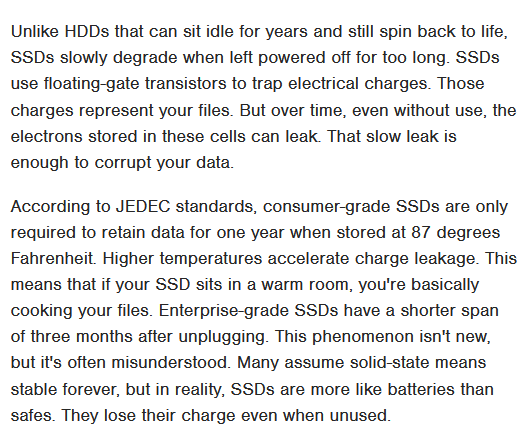
TIL that SSDs can lose data if left unplugged for long periods of time (only required to hold data up to 1 year), unlike HDDs which as long as the material holds it can take years.
-
@raymaccarthy @djlink the statement "if left unplugged" is at best misleading (but really, just a misunderstanding) because data will fade regardless of the SSD being powered or not. And the cited 1 a data retention is also a misunderstanding of test conditions, as overly extensively explained.
-
@raymaccarthy @djlink that's because of cost per bit, not because of reliability.
-
@raymaccarthy @djlink now you're just listing obsolete storage technologies, (I don't know project Xanadu) which all have many orders of magnitudes worse bit error rates than modern SSDs.
@funkylab @djlink
It's a matter of perspective. Certainly Zip drives were ghastly. I don't know how long term bubble memory was, but there is lots of stuff more reliable than consumer SSDs or 1T micro SD cards. Also the sudden complete loss of an SD card or SSD (256G to 1000 G) compared to errors on one file on a floppy (0.00144G or even 0.0001) are alarming. -
@funkylab @djlink
It's a matter of perspective. Certainly Zip drives were ghastly. I don't know how long term bubble memory was, but there is lots of stuff more reliable than consumer SSDs or 1T micro SD cards. Also the sudden complete loss of an SD card or SSD (256G to 1000 G) compared to errors on one file on a floppy (0.00144G or even 0.0001) are alarming.@raymaccarthy @djlink you're following nostalgia there, not engineering. you need yo realize that all these ancient storage techniques never amounted to as much storage as your SSD. I'm not even sure there ever was a cumulative Gigabit in bubble storage, and if you read that out, it'd have several thousand errors. Much worse than an SD card left in a desk drawer for a couple of yeara, for sure!
-
@raymaccarthy @djlink that's because of cost per bit, not because of reliability.
@funkylab @djlink
There were notoriously unreliable tape cartridge systems. Travan?
Customers hated the cost and time to do backups and our insistence that without the time consuming verification how did they know it was a backup?
Also hard to get customers to accept that RAID 1 or 5 was for high availability, that they STILL needed a backup. Ideally also extra copies off site.
I still have an external SCSI tape drive in the attic. It would need about 500 tapes for one backup. -
@raymaccarthy @djlink you're following nostalgia there, not engineering. you need yo realize that all these ancient storage techniques never amounted to as much storage as your SSD. I'm not even sure there ever was a cumulative Gigabit in bubble storage, and if you read that out, it'd have several thousand errors. Much worse than an SD card left in a desk drawer for a couple of yeara, for sure!
@raymaccarthy @djlink "reliability" is measured in "errors per bit" and not in "errors per usual size of medium when the medium was new"
-
@funkylab @djlink
There were notoriously unreliable tape cartridge systems. Travan?
Customers hated the cost and time to do backups and our insistence that without the time consuming verification how did they know it was a backup?
Also hard to get customers to accept that RAID 1 or 5 was for high availability, that they STILL needed a backup. Ideally also extra copies off site.
I still have an external SCSI tape drive in the attic. It would need about 500 tapes for one backup.@raymaccarthy @djlink yes, I understand you have extensive experience in long-obsolete storage tech.
-
@raymaccarthy @djlink you're following nostalgia there, not engineering. you need yo realize that all these ancient storage techniques never amounted to as much storage as your SSD. I'm not even sure there ever was a cumulative Gigabit in bubble storage, and if you read that out, it'd have several thousand errors. Much worse than an SD card left in a desk drawer for a couple of yeara, for sure!
@funkylab @djlink
Easier to backup a 40 M Byte HDD.
I'm totally amazed by the sheer qty of photos etc people lose because they don't backup their SSD.
Years ago it was accounts and payrolls they lost on HDDs that died.Hah, well at least the last idiot I sorted had their bitlocker key in Excel on "cloud" account. All the PhD work. No backup and an all-in-one-workstation (laptop like Mobo in the screen without advantage of laptop battery). It was an HDD, but an SSD would have been no harder.
-
@funkylab @djlink
Easier to backup a 40 M Byte HDD.
I'm totally amazed by the sheer qty of photos etc people lose because they don't backup their SSD.
Years ago it was accounts and payrolls they lost on HDDs that died.Hah, well at least the last idiot I sorted had their bitlocker key in Excel on "cloud" account. All the PhD work. No backup and an all-in-one-workstation (laptop like Mobo in the screen without advantage of laptop battery). It was an HDD, but an SSD would have been no harder.
@raymaccarthy @djlink now you're wandering off into the wilds, talking to the forest about backing up systems that in 2026 nobody has had to make backups for in more than thirty years… I think I'll leave you to it.
-
@raymaccarthy @djlink now you're wandering off into the wilds, talking to the forest about backing up systems that in 2026 nobody has had to make backups for in more than thirty years… I think I'll leave you to it.
-
TIL that SSDs can lose data if left unplugged for long periods of time (only required to hold data up to 1 year), unlike HDDs which as long as the material holds it can take years.
Edit: added link: https://www.slashgear.com/1893447/dont-leave-your-old-ssd-unplugged/
@djlink@mastodon.gamedev.place Wow Enterprise SSDs are even worse in retaining data.
Though that makes sense, too. -
@raymaccarthy @djlink yeah, sure
-
TIL that SSDs can lose data if left unplugged for long periods of time (only required to hold data up to 1 year), unlike HDDs which as long as the material holds it can take years.
Edit: added link: https://www.slashgear.com/1893447/dont-leave-your-old-ssd-unplugged/
@djlink Don't HDDs still lose some of the magnetism over time even while the media is good? And you can't just plug it back in to fix that either. You have to rewrite the data.
I don't know about the standards only requiring SSDs to last one year. I guess it varies by device and manufacturer, but I have never seen a solid state storage device lose data remotely close to that quickly. I've never actually had any of mine lose data just in a normal lifetime of normal usage. Heck, my old 128MB USB flash drive that I used on my PS2 still works and I haven't even plugged that in in something like ten years. (Dust bunnies galore!) I recently turned on my even older Cowon D2 DAP (like a MP3 player but can do videos) and it still worked after more than 10 years... (I think it's NAND.)
-
TIL that SSDs can lose data if left unplugged for long periods of time (only required to hold data up to 1 year), unlike HDDs which as long as the material holds it can take years.
Edit: added link: https://www.slashgear.com/1893447/dont-leave-your-old-ssd-unplugged/
@djlink This claim pops up from time to time and has for a damn decade. https://www.pcworld.com/article/427602/debunked-your-ssd-wont-lose-data-if-left-unplugged-after-all.html
-
TIL that SSDs can lose data if left unplugged for long periods of time (only required to hold data up to 1 year), unlike HDDs which as long as the material holds it can take years.
Edit: added link: https://www.slashgear.com/1893447/dont-leave-your-old-ssd-unplugged/
@djlink Same goes for SD Cards and similar. :3 -
@raymaccarthy @djlink I honestly find the opposite to be the case - HDDs can expose mechanical degradations (air barriers, motor bearings) that tend to work against you when you leave them unpowered. But this isn't about HDDs; it's about the myth that powering on an SSD will help data retention.
@funkylab @raymaccarthy @djlink Nice SSDs do have a sort of patrol scrub. They read the pages and measure how much of the error correction capacity is used to get useful data out. If it passes a certain threshold, the data is rewritten. It’s a relatively slow process, since the vendors don’t want it stealing IOPS from the workload. The ones I’ve seen take a few days to check everything.
That’s the only real way applied power affects the data retention of an SSD.
-
@funkylab @raymaccarthy @djlink Nice SSDs do have a sort of patrol scrub. They read the pages and measure how much of the error correction capacity is used to get useful data out. If it passes a certain threshold, the data is rewritten. It’s a relatively slow process, since the vendors don’t want it stealing IOPS from the workload. The ones I’ve seen take a few days to check everything.
That’s the only real way applied power affects the data retention of an SSD.
@bob_zim @raymaccarthy @djlink oh has that made it to client SSDs? Nice!
-
TIL that SSDs can lose data if left unplugged for long periods of time (only required to hold data up to 1 year), unlike HDDs which as long as the material holds it can take years.
Edit: added link: https://www.slashgear.com/1893447/dont-leave-your-old-ssd-unplugged/
@djlink To be clear though, for readers who don't already know - the data on HDD platters won't corrupt and be lost, but the mechanism may seize or fail (for instance due to grease settling out of the places it should be, or metal on metal parts binding), especially if not stored in ideal, stable temperature and humidity. While a data recovery firm could likely overcome that, it's not a cheap solution.
-
TIL that SSDs can lose data if left unplugged for long periods of time (only required to hold data up to 1 year), unlike HDDs which as long as the material holds it can take years.
Edit: added link: https://www.slashgear.com/1893447/dont-leave-your-old-ssd-unplugged/
@djlink This is very interesting. Most of the documents and photos used in courts these days are admitted in electronic form - on thumb drives/flash drives. It seems that in the long term there may be no historical record.
-
@funkylab @raymaccarthy @djlink Nice SSDs do have a sort of patrol scrub. They read the pages and measure how much of the error correction capacity is used to get useful data out. If it passes a certain threshold, the data is rewritten. It’s a relatively slow process, since the vendors don’t want it stealing IOPS from the workload. The ones I’ve seen take a few days to check everything.
That’s the only real way applied power affects the data retention of an SSD.
@funkylab @raymaccarthy @djlink Reports of tape or conventional hard drives lasting decades are largely survivorship bias. Nobody talks about the tapes which decayed from poor storage or the disks with phenolic boards which crumble when you look at them. They *are likely* to retain usable data for longer than SSDs *are likely* to retain usable data, but there’s huge overlap between those curves.
The only real way to store data long-term and ensure it remains readable is to test it periodically (e.g, a ZFS scrub). Media failures are inevitable. The best approach is designing for this and testing to catch the faults before they overcome the fault tolerance of the system.