"Minimum wage" is one of those odd concepts that *seems* to have an intuitive definition, but the harder you think about it, the more complicated it gets.
-
When Toronto grappled with the brutal effect gig-work taxis have on the city's world-beatingly bad traffic, Uber promised to pay its drivers "120% of the minimum wage," which would come out to $21.12 per hour. However, the *real* wage Uber was proposing to pay its drivers came out to about *$2.50* per hour:
https://pluralistic.net/2024/02/29/geometry-hates-uber/#toronto-the-gullible
How to explain the difference? Well, Uber - and its gig-work competitors - only pay drivers while they have a passenger - or an item - in the car.
7/
Drivers aren't paid for time they spend waiting for a job or time they spend getting to the job. This is the majority of time that a gig driver spends working for the platform, and by excluding the majority of time a driver is on the clock, the company can claim to pay a generous wage while actually paying peanuts.
Now, at this phase, you may be thinking that this is only fair, or at least traditional. Livery cab drivers don't get paid unless they have a fare in the cab, right?
8/
-
Drivers aren't paid for time they spend waiting for a job or time they spend getting to the job. This is the majority of time that a gig driver spends working for the platform, and by excluding the majority of time a driver is on the clock, the company can claim to pay a generous wage while actually paying peanuts.
Now, at this phase, you may be thinking that this is only fair, or at least traditional. Livery cab drivers don't get paid unless they have a fare in the cab, right?
8/
That's true, but livery cab drivers have lots of ways to influence that number. They can shrewdly choose a good spot to cruise. They can give their cellphone numbers to riders they've established a rapport with in order to win advance bookings. In small towns with just a few drivers - or in cities where drivers are in a co-op - they can spend some of their earnings to advertise the taxi company. Livery drivers can offer discounts to riders going a long way.
9/
-
That's true, but livery cab drivers have lots of ways to influence that number. They can shrewdly choose a good spot to cruise. They can give their cellphone numbers to riders they've established a rapport with in order to win advance bookings. In small towns with just a few drivers - or in cities where drivers are in a co-op - they can spend some of their earnings to advertise the taxi company. Livery drivers can offer discounts to riders going a long way.
9/
It's a tough job, but it's one in which workers have some *agency*.
Contrast that with driving for Uber: Uber decides which drivers get to even see a job. Uber decides how to market its services. Uber gets to set fares, on a per-passenger basis, meaning that it might choose to scare some passengers off of a few of their rides with high prices, in a bid to psychologically nudge that passenger into accepting higher fares overall.
10/
-
It's a tough job, but it's one in which workers have some *agency*.
Contrast that with driving for Uber: Uber decides which drivers get to even see a job. Uber decides how to market its services. Uber gets to set fares, on a per-passenger basis, meaning that it might choose to scare some passengers off of a few of their rides with high prices, in a bid to psychologically nudge that passenger into accepting higher fares overall.
10/
At the same time, Uber is reliant on a minimum pool of drivers cruising the streets, on the clock but off the payroll. If riders had to wait 45 minutes to get an Uber, they'd make other arrangements. If it happened too often, they'd delete the app. So Uber can't survive without those cruising, unpaid drivers, who provide the capacity that make the company commercially viable.
11/
-
At the same time, Uber is reliant on a minimum pool of drivers cruising the streets, on the clock but off the payroll. If riders had to wait 45 minutes to get an Uber, they'd make other arrangements. If it happened too often, they'd delete the app. So Uber can't survive without those cruising, unpaid drivers, who provide the capacity that make the company commercially viable.
11/
What's more, livery cab drivers aren't the only comparators for gig-work platforms. Many gig workers deliver food, meaning that we should compare them to, say, pizza delivery drivers. These drivers aren't just paid when they have a pizza in the car and they're driving to a customer's home. They're paid from the moment they clock onto their shift to the moment they clock off (plus tips).
12/
-
What's more, livery cab drivers aren't the only comparators for gig-work platforms. Many gig workers deliver food, meaning that we should compare them to, say, pizza delivery drivers. These drivers aren't just paid when they have a pizza in the car and they're driving to a customer's home. They're paid from the moment they clock onto their shift to the moment they clock off (plus tips).
12/
Now, obviously, this is more expensive for employers, but the Uber Eats arrangement - in which drivers are only paid when they've got a pizza in the car and they're en route to a customer - doesn't eliminate that expense. When a gig delivery company takes away the pay that drivers used to get while waiting for a pizza, they're shifting this expense from employers to workers:
https://pluralistic.net/2025/08/20/billionaireism/#surveillance-infantalism
13/
-
Now, obviously, this is more expensive for employers, but the Uber Eats arrangement - in which drivers are only paid when they've got a pizza in the car and they're en route to a customer - doesn't eliminate that expense. When a gig delivery company takes away the pay that drivers used to get while waiting for a pizza, they're shifting this expense from employers to workers:
https://pluralistic.net/2025/08/20/billionaireism/#surveillance-infantalism
13/
The fact that Uber can manipulate the concept of a minimum wage in order to claim to pay $21.12/hour to drivers who are making $2.50 per hour creates all kinds of policy distortions.
Take Seattle: in 2024, the city implemented a program called "PayUp" that sets a "minimum wage" for drivers, but it's not a real minimum wage. It's a minimum payment for every ride or delivery.
14/
-
I'm talking about how gig-work platforms define workers' wages in the first place. This is a very salient definition in public policy debates. Gig platforms facing regulation or investigation routinely claim that their workers are paid sky-high wages. During the debate over California's Prop 22 (in which Uber and Lyft spent more than $225m to formalize worker misclassification), gig companies agreed to all kinds of reasonable-sounding wage guarantees:
https://pluralistic.net/2020/10/14/final_ver2/#prop-22
6/
@pluralistic granted, anyone who honestly.worked any #GigWork will tell you that it sucks ass!
-
The fact that Uber can manipulate the concept of a minimum wage in order to claim to pay $21.12/hour to drivers who are making $2.50 per hour creates all kinds of policy distortions.
Take Seattle: in 2024, the city implemented a program called "PayUp" that sets a "minimum wage" for drivers, but it's not a real minimum wage. It's a minimum payment for every ride or delivery.
14/
A new National Bureau of Economic Research paper analyzes the program and concludes that it hasn't increased drivers' pay at all:
https://www.nber.org/papers/w34545
To which we might say, "Duh." Cranking up the sum paid for a small fraction of the work you do for a company will have very little impact on the overall wage you receive from the company.
15/
-
A new National Bureau of Economic Research paper analyzes the program and concludes that it hasn't increased drivers' pay at all:
https://www.nber.org/papers/w34545
To which we might say, "Duh." Cranking up the sum paid for a small fraction of the work you do for a company will have very little impact on the overall wage you receive from the company.
15/
However, there *is* an interesting wrinkle in this paper's conclusions. Drivers aren't earning *less* under this system, either. So they're getting paid more for every delivery, but they're not adding more deliveries to their day. In other words, they're doing less work and then clocking off:
https://marginalrevolution.com/marginalrevolution/2026/02/minimum-wages-for-gig-work-cant-work.html
16/
-
However, there *is* an interesting wrinkle in this paper's conclusions. Drivers aren't earning *less* under this system, either. So they're getting paid more for every delivery, but they're not adding more deliveries to their day. In other words, they're doing less work and then clocking off:
https://marginalrevolution.com/marginalrevolution/2026/02/minimum-wages-for-gig-work-cant-work.html
16/
A neoclassical economist (someone who has experienced a specific form of neurological injury that makes you incapable of perceiving or reasoning about power) would say that this means that the drivers only desire to earn the sums they were earning before the "minimum wage" and so the program hasn't made a difference to their lives.
17/
-
A neoclassical economist (someone who has experienced a specific form of neurological injury that makes you incapable of perceiving or reasoning about power) would say that this means that the drivers only desire to earn the sums they were earning before the "minimum wage" and so the program hasn't made a difference to their lives.
17/
Anyone else looks at this situation and understands drivers only did this shitty job out of desperation. They had a sum they *needed* every month in order to pay the rent or the grocery bill. They have lots of needs besides those that they would like to fulfill, but not under the shitty gig-work app conditions. The only reason they tolerate a shitty app as their shitty boss at all is that they are desperate, and that desperation gives gig companies power over their workers.
18/
-
Anyone else looks at this situation and understands drivers only did this shitty job out of desperation. They had a sum they *needed* every month in order to pay the rent or the grocery bill. They have lots of needs besides those that they would like to fulfill, but not under the shitty gig-work app conditions. The only reason they tolerate a shitty app as their shitty boss at all is that they are desperate, and that desperation gives gig companies power over their workers.
18/
In other words, Seattle's PayUp "minimum wage" has shifted some of the expense associated with operating a gig platform from workers back onto their bosses. With fewer drivers available on the app, waiting times for customers will necessarily go up. Some of those customers will take the bus, or get a livery cab, or defrost a pizza, or walk to the corner cafe.
19/
-
In other words, Seattle's PayUp "minimum wage" has shifted some of the expense associated with operating a gig platform from workers back onto their bosses. With fewer drivers available on the app, waiting times for customers will necessarily go up. Some of those customers will take the bus, or get a livery cab, or defrost a pizza, or walk to the corner cafe.
19/
For the gig platforms to win those customers back, they will have to reduce waiting times, and the most reliable way to do that is to increase the wages paid to their workers.
So PayUp isn't a wash - it has changed the distributional outcome of the gig-work economy in Seattle.
20/
-
When Toronto grappled with the brutal effect gig-work taxis have on the city's world-beatingly bad traffic, Uber promised to pay its drivers "120% of the minimum wage," which would come out to $21.12 per hour. However, the *real* wage Uber was proposing to pay its drivers came out to about *$2.50* per hour:
https://pluralistic.net/2024/02/29/geometry-hates-uber/#toronto-the-gullible
How to explain the difference? Well, Uber - and its gig-work competitors - only pay drivers while they have a passenger - or an item - in the car.
7/
@pluralistic which is absurd.
- But not uncommon.
At least in #Germany they've to payvpeople during their working shift at least minimum wage.
-
For the gig platforms to win those customers back, they will have to reduce waiting times, and the most reliable way to do that is to increase the wages paid to their workers.
So PayUp isn't a wash - it has changed the distributional outcome of the gig-work economy in Seattle.
20/
Drivers have clawed back a surplus - time they can spend doing more productive or pleasant things than cruising and waiting for a booking - from their bosses, who now must face lower profits, either from a loss of business from impatient customers, or from a higher wage they must pay to get those wait-times down again.
21/
-
Drivers have clawed back a surplus - time they can spend doing more productive or pleasant things than cruising and waiting for a booking - from their bosses, who now must face lower profits, either from a loss of business from impatient customers, or from a higher wage they must pay to get those wait-times down again.
21/
But if you want to *really* move the needle on gig workers' wages, the answer is simple: pay workers for *all* the hours they put in for their bosses, not just the ones where bosses decide they deserve to get paid for.
22/
-
But if you want to *really* move the needle on gig workers' wages, the answer is simple: pay workers for *all* the hours they put in for their bosses, not just the ones where bosses decide they deserve to get paid for.
22/
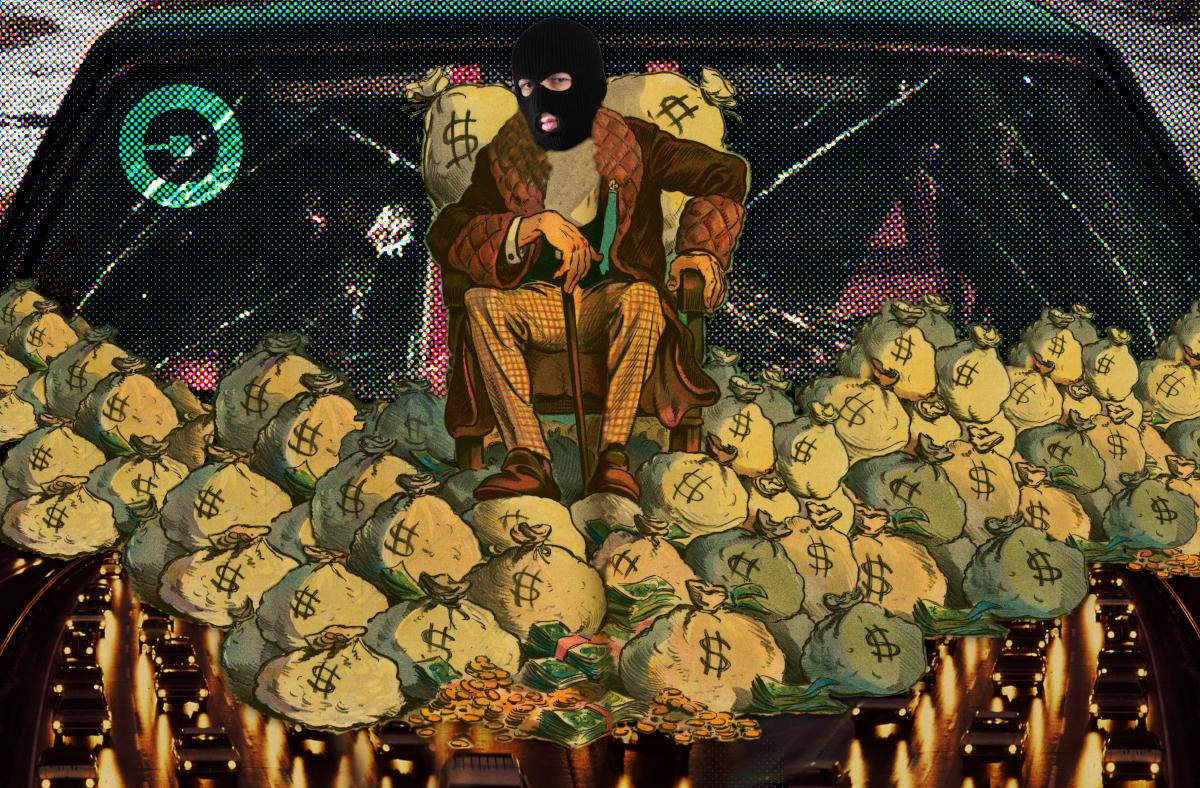
Image:
Tobias "ToMar" Maier (modified)
https://commons.wikimedia.org/wiki/File:Balaclava_3_hole_black.jpgCC BY-SA 3.0
https://creativecommons.org/licenses/by-sa/3.0/deed.en--
Jon Feinstein (modified)
https://www.flickr.com/photos/jonfeinstein/186791934/CC BY 2.0
https://creativecommons.org/licenses/by/2.0/deed.eneof/
-
However, there *is* an interesting wrinkle in this paper's conclusions. Drivers aren't earning *less* under this system, either. So they're getting paid more for every delivery, but they're not adding more deliveries to their day. In other words, they're doing less work and then clocking off:
https://marginalrevolution.com/marginalrevolution/2026/02/minimum-wages-for-gig-work-cant-work.html
16/
@pluralistic it's a crime that they don't get paid minimum wage whilst being clocked in…
-
"Minimum wage" is one of those odd concepts that *seems* to have an intuitive definition, but the harder you think about it, the more complicated it gets. For example, if you want to work, but can't find a job, then the minimum wage you'll get is zero:
--
If you'd like an essay-formatted version of this thread to read or share, here's a link to it on pluralistic.net, my surveillance-free, ad-free, tracker-free blog:
https://pluralistic.net/2026/02/17/no-piecework/#no-justice
1/
@pluralistic "A neoclassical economist (someone who has experienced a specific form of neurological injury that makes you incapable of perceiving or reasoning about power)"
That is one of the best descriptions I read in a long while.