I’ve been thinking about this for days.
-
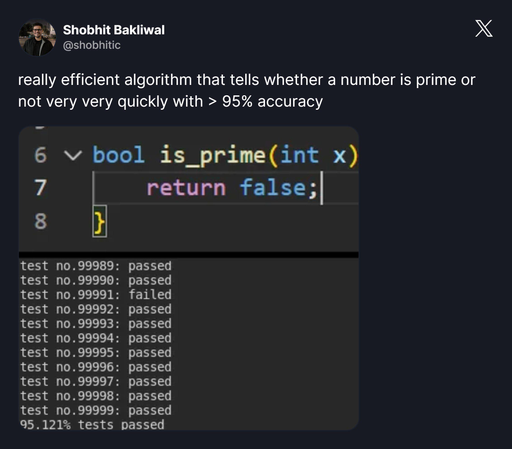
I’ve been thinking about this for days. Incredible stochastic algorithm, gets more reliable the larger your input, incredibly fast, trivial to implement and deterministic on its inputs. It really has so much going for it.
(Via @jonathankoren )
-
I’ve been thinking about this for days. Incredible stochastic algorithm, gets more reliable the larger your input, incredibly fast, trivial to implement and deterministic on its inputs. It really has so much going for it.
(Via @jonathankoren )
@mhoye @jonathankoren And no false positives!
-
@mhoye @jonathankoren And no false positives!
@sellout @jonathankoren right!?
-
I’ve been thinking about this for days. Incredible stochastic algorithm, gets more reliable the larger your input, incredibly fast, trivial to implement and deterministic on its inputs. It really has so much going for it.
(Via @jonathankoren )
@mhoye @jonathankoren wow, so much more efficient than the state-of-the-art algorithm: asking a LLM whether x is prime
-
@sellout @jonathankoren right!?
@mhoye @sellout @jonathankoren
It's accuracy asymptotically approaches 100%
That's amazing!
Slight cavities about using it for cryptographic purposes or around smallish numbers. -
I’ve been thinking about this for days. Incredible stochastic algorithm, gets more reliable the larger your input, incredibly fast, trivial to implement and deterministic on its inputs. It really has so much going for it.
(Via @jonathankoren )
@jonathankoren @mhoye they’re all good algorithms, Brent
-
@jonathankoren @mhoye they’re all good algorithms, Brent
-
I’ve been thinking about this for days. Incredible stochastic algorithm, gets more reliable the larger your input, incredibly fast, trivial to implement and deterministic on its inputs. It really has so much going for it.
(Via @jonathankoren )
@mhoye @jonathankoren it's branchless too, and easily parallelized onto a GPU to speed it up
-
I’ve been thinking about this for days. Incredible stochastic algorithm, gets more reliable the larger your input, incredibly fast, trivial to implement and deterministic on its inputs. It really has so much going for it.
(Via @jonathankoren )
@mhoye @jonathankoren @daedalus I hope the crypto crew catch wind of this. Has potential to save a lot of electricity
-
@jonathankoren @adardis @mhoye this is like that weather aphorism, isn't it
-
I’ve been thinking about this for days. Incredible stochastic algorithm, gets more reliable the larger your input, incredibly fast, trivial to implement and deterministic on its inputs. It really has so much going for it.
(Via @jonathankoren )
@mhoye @jonathankoren @rmondello Surprising fact: exactly the same algorithm works even better for many other problems: perfect numbers, powers of two, busy beaver, etc.
-
I’ve been thinking about this for days. Incredible stochastic algorithm, gets more reliable the larger your input, incredibly fast, trivial to implement and deterministic on its inputs. It really has so much going for it.
(Via @jonathankoren )
The problem is its inaccuracy for smaller input sets involving low-digit-count numbers.
Trivially fixed by hardcoding the results for 3-digit and lower input. Ship it!
-
@jonathankoren @adardis @mhoye Can I quote you on that?
-
@jonathankoren @adardis @mhoye Can I quote you on that?
@drwho @jonathankoren @adardis It's such a good line.
-
I’ve been thinking about this for days. Incredible stochastic algorithm, gets more reliable the larger your input, incredibly fast, trivial to implement and deterministic on its inputs. It really has so much going for it.
(Via @jonathankoren )
@mhoye @jonathankoren It also provides the script for a math party trick: "Tell me any 100 digit number and I will tell you if it's prime!'
-
@jonathankoren @adardis @mhoye Can I quote you on that?
-
R ActivityRelay shared this topic