TIL that SSDs can lose data if left unplugged for long periods of time (only required to hold data up to 1 year), unlike HDDs which as long as the material holds it can take years.
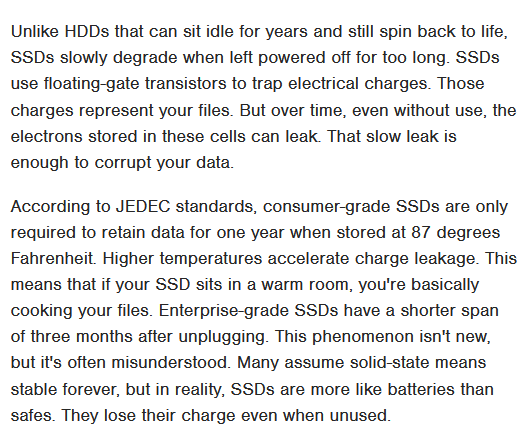
-
TIL that SSDs can lose data if left unplugged for long periods of time (only required to hold data up to 1 year), unlike HDDs which as long as the material holds it can take years.
Edit: added link: https://www.slashgear.com/1893447/dont-leave-your-old-ssd-unplugged/
@djlink I can attest with both research and anecdata.
TL;DR do not fill up your SSD to make it persist in a drawer. The less it keeps, the longer it keeps. Write backups to the hot device, keep your drawer cold.1. Most high capacity SSD nowadays use dynamic configuration for blocks, with vital areas like ECC or most hot data being kept in blocks configured as SLC. So in "pro" products with >75% free space everything will be in SLC configured blocks. Then hot data will migrate to 2b/c blocks. If medium (chips) the longevity will be worse. A decade ago most versed in technology hackers were statically reprogramming TLC areas to SLC. Now this belongs to the controller.
2. For most flash media technologies on the market the Δt° between write and storage matters. Longevity increases if cell was written hot then stored cold. Some TLC pendrive makers knew that, then got bashed by unaware customers complaining.
3. side note: contrary to popular understanding, it is not the "write" that wears-out cells, but "erase" operation.
https://dl.acm.org/doi/10.1145/3487064Anecdata: last lasting flash SSDs I have were made of 19nm 2b/cell chips from Toshiba. Then were marketed as MLC. Two year drawer rest was ok, 4yr was too long. Filled-up TLC SSDs after year retained only directory structure. What made me to research I shared. TC.
-
TIL that SSDs can lose data if left unplugged for long periods of time (only required to hold data up to 1 year), unlike HDDs which as long as the material holds it can take years.
Edit: added link: https://www.slashgear.com/1893447/dont-leave-your-old-ssd-unplugged/
@djlink Oh god yes; they're just big pen drives. OK for gaming if in constant use in a gaming PC (instant access/high speed) but shiiiiiiit if you use them for storage and don't have them on all the time.
-
TIL that SSDs can lose data if left unplugged for long periods of time (only required to hold data up to 1 year), unlike HDDs which as long as the material holds it can take years.
Edit: added link: https://www.slashgear.com/1893447/dont-leave-your-old-ssd-unplugged/
@djlink wow, thanks for letting me know
-
TIL that SSDs can lose data if left unplugged for long periods of time (only required to hold data up to 1 year), unlike HDDs which as long as the material holds it can take years.
Edit: added link: https://www.slashgear.com/1893447/dont-leave-your-old-ssd-unplugged/
hahah, a WD drive that sits for about 5-8 years loses so much data its own firmware isn't likley to be there anymore.
-
-
@djlink IMO the only material proven to hold digital data for decades at this point is tape, as evidenced by the tape reels they keep finding in storage warehouses whose contents are successfully read back https://www.tomshardware.com/software/linux/recovered-unix-v4-tape-quickly-yields-a-usable-operating-system-nostalgia-addicts-can-now-boot-up-unix-v4-in-a-browser-window
I suppose HDDs can hold archival data, but there are way more ways for spinning discs to fail than tape when stored for long periods of time. But maybe we can use magnetic microscopy to recover their data even if their circuits have died, their motors have failed, or their lubricants have died out. https://garnerproducts.com/hubfs/ucsd_recovery_of_partially_degaussed-hdds.pdf
@drahardja @djlink
If you make that paper tape, true. Though I believe punch cards are tougher.Magnetic tape rests against itself, which for audio tape results in an audible echo building over time, but presumably digital tape drives ignore the echo until it reaches a certain level.
Paper tape and punch cards have no such problems.
-
-
@funkylab @raymaccarthy @djlink Reports of tape or conventional hard drives lasting decades are largely survivorship bias. Nobody talks about the tapes which decayed from poor storage or the disks with phenolic boards which crumble when you look at them. They *are likely* to retain usable data for longer than SSDs *are likely* to retain usable data, but there’s huge overlap between those curves.
The only real way to store data long-term and ensure it remains readable is to test it periodically (e.g, a ZFS scrub). Media failures are inevitable. The best approach is designing for this and testing to catch the faults before they overcome the fault tolerance of the system.
-
@ChuckMcManis @djlink I’d be so afraid of “bit rot” like we saw on earlier Laserdisks… but that was decades ago.
-
TIL that SSDs can lose data if left unplugged for long periods of time (only required to hold data up to 1 year), unlike HDDs which as long as the material holds it can take years.
Edit: added link: https://www.slashgear.com/1893447/dont-leave-your-old-ssd-unplugged/
@djlink I've kept one of my external SSDs on top of my computer for like a year, so I haven't been cooking my files so much as I have been flame-grilling them.
-
@djlink I've kept one of my external SSDs on top of my computer for like a year, so I haven't been cooking my files so much as I have been flame-grilling them.
@djlink The good news is there's nothing on there I don't have backups of elsewhere.
-
TIL that SSDs can lose data if left unplugged for long periods of time (only required to hold data up to 1 year), unlike HDDs which as long as the material holds it can take years.
Edit: added link: https://www.slashgear.com/1893447/dont-leave-your-old-ssd-unplugged/
@djlink I learned this through bitter experience. 6 months in a warm room was enough to lose everything.
-
TIL that SSDs can lose data if left unplugged for long periods of time (only required to hold data up to 1 year), unlike HDDs which as long as the material holds it can take years.
Edit: added link: https://www.slashgear.com/1893447/dont-leave-your-old-ssd-unplugged/
@djlink Not only can they lose data but they can simply irrecoverably stop working if you leave them more than a year or so unplugged - dead as a doornail.
Spinny rust these days is not vastly better because the flash holding the firmware is better but not a lot better.
-
@lispi314 @djlink @raymaccarthy @funkylab Some years ago a quaker friend was discussing options for electronic storage of their records (which they keep and readable with great care for vast times). They did indeed decide to continue to keep them on paper both because of uncertainties around digital storage media, but also because they were worried that 80 years from now someone might not have the software or information to recover some digital media type.
-
@raymaccarthy @djlink I'm really not sure where the idea that a powered SSD would be more reliable than an unpowered one – that could only be true if it would be re-writing itself in the background, which would, counter to the intent, make it wear out faster, unless the SSD is essentially unused and the re-writing was free to use arbitrary much rarely or never used pages to copy the data to. But even that would be very undesirable – who wants an SSD with a standby power usage as if written to?)
@funkylab @raymaccarthy @djlink Modern SSDs do patrol scrubbing so they do indeed rewrite bad information or marginal data when needed.
Spinny rust has btw done the same thing for many years too, some spinny rust is even smart enough to relocate data behind your back so you don't even find out about the bit of the disk that's getting dodgy for some reason. -
@funkylab @djlink
Not powered off they don't.
An HDD can wear out with use but 25 years is easy for storage in a drawer or box in the attic. Floppy storage is far trickier.
Tape needs carefully stored.
Pressed DVDs* and especially pressed CDs are OK, but "written" ones can fade in daylight.[* Assuming no manufacturing defects]
@raymaccarthy @funkylab @djlink Hard disks also wear out if stored. However your wear is mostly component failures, oxidisation and so on so quite slow. The flash chips on the hard disk drive today will also eventually dribble their brains out and it won't work any more but the flash used is generally rather less vulnerable than the very high density flash used in an SSD.
Unlike the SSD though your HDD media is more recoverable even if the electronics is dead.
-
-
@raymaccarthy @funkylab @djlink Hard disks also wear out if stored. However your wear is mostly component failures, oxidisation and so on so quite slow. The flash chips on the hard disk drive today will also eventually dribble their brains out and it won't work any more but the flash used is generally rather less vulnerable than the very high density flash used in an SSD.
Unlike the SSD though your HDD media is more recoverable even if the electronics is dead.
@etchedpixels @funkylab @djlink
One person had a PSU that fried everything. Tops blown off chips on the HDD PCB. I swapped the PCB for one off a same model 1T HDD & was able to recover all the data.
Electrolytic capacitors can dry out & the old paper ones before the 1960s went high leakage, though only an issue on higher voltages.
People have restored electronics up to 100 years old without much bother. After the 1960s mostly some electrolytic capacitors. Replace NiCd with NiMH batteries etc. -
@funkylab @raymaccarthy @djlink Modern SSDs do patrol scrubbing so they do indeed rewrite bad information or marginal data when needed.
Spinny rust has btw done the same thing for many years too, some spinny rust is even smart enough to relocate data behind your back so you don't even find out about the bit of the disk that's getting dodgy for some reason.@etchedpixels @funkylab @djlink
SMART reporting on HDDs should reveal lots. Most Linux distros have a tool already installed to read SMART data and test HDDs. -
@raymaccarthy @djlink I'm really not sure where the idea that a powered SSD would be more reliable than an unpowered one – that could only be true if it would be re-writing itself in the background, which would, counter to the intent, make it wear out faster, unless the SSD is essentially unused and the re-writing was free to use arbitrary much rarely or never used pages to copy the data to. But even that would be very undesirable – who wants an SSD with a standby power usage as if written to?)
@funkylab Honestly you come across as condescending with your posts. Please don't.
- Trimming, voltage drift scrubbing, and wear leveling will cause data to constantly get re-written.
- While Single Level Cell NAND can hold your data for a decade, QLC can lose data within 1-2 years when left unpowered.
- Controllers are aware of this and can counter this if they're powered.Example sources:
- https://www.xda-developers.com/your-unpowered-ssd-is-slowly-losing-your-data/
- https://www.seagate.com/files/staticfiles/docs/pdf/whitepaper/tp618-ssd-tech-paper-us.pdfSSDs are leaky capacitors.
-
R ActivityRelay shared this topic